Showing posts with label Historical Fiction. Show all posts

Monday, September 7, 2015

Church History for Children

We've used these books to introduce some Church History to our children when they were about 8  years old and up. Some of them I read aloud but they are all suitable for children to read on their own. Moozle (10 years old) has just finished going through all the Louise Vernon titles again recently. Vernon's books are fictional but they are mostly set in the time of the Reformation and introduce the great events and people of Church History in a way children can understand and relate to. There are twelve books that I know of, illustrated every now and then with black ink, and they are on average about 125 pages in length. Here are a few that have been well read in our home:

Ink on His Fingers


An exciting story centred around the printing of the first Bible after Johann Gutenberg's invention of moveable type in the 1450's.


The Man Who Laid the Egg

The story of Desiderius Erasmus (1466-1536) who has been called the intellectual father of the Reformation, seen through the eyes of a young apprentice.

'Erasmus laid the egg, and Luther hatched it.'


Thunderstorm in the Church

Martin Luther seen through the eyes of his son. 'Through Han's eyes you will learn to know Martin Luther - not only as the great Reformer-preacher, but also as a father with a sense of humor and as a friend.'


A Heart Strangely Warmed

Young Robert Upton was peddling his father's goods when he meets John Wesley, a fiery little man who is preaching on the streets of London. Heend Wesley's meetings and gradually Robert begins to understand Wesley's message and feels like Wesley described in his Journal below, that his heart is strangely warmed.'

In the evening I went very unwillingly to a society in Aldersgate Street, where one was reading Luther’s preface to the Epistle to the Romans. About a quarter before nine, while he was describing the change which God works in the heart through faith in Christ, I felt my heart strangely warmed. I felt I did trust in Christ, Christ alone, for salvation; and an assurance was given me that He had taken away my sins, even mine, and saved me from the law of sin and death.


Other books by Louise Vernon which are all good and cover some lesser known aspects of Church History are:

The Beggar's Bible (JohnWycliffe)
The Bible Smuggler (William Tyndale)
 Key to the Prison (George Fox & the Quakers)
The King's Book ( The King James Bible translation)
Peter & the Pilgrims (English Separatists & Pilgrims)
Night Preacher (Menno Simons)
The Secret Church (Anabaptists)
Strangers in the Land (Huguenots)
And one which we haven't read, and don't have - Doctor in Rags (Paracelsus & the Hutterites) 


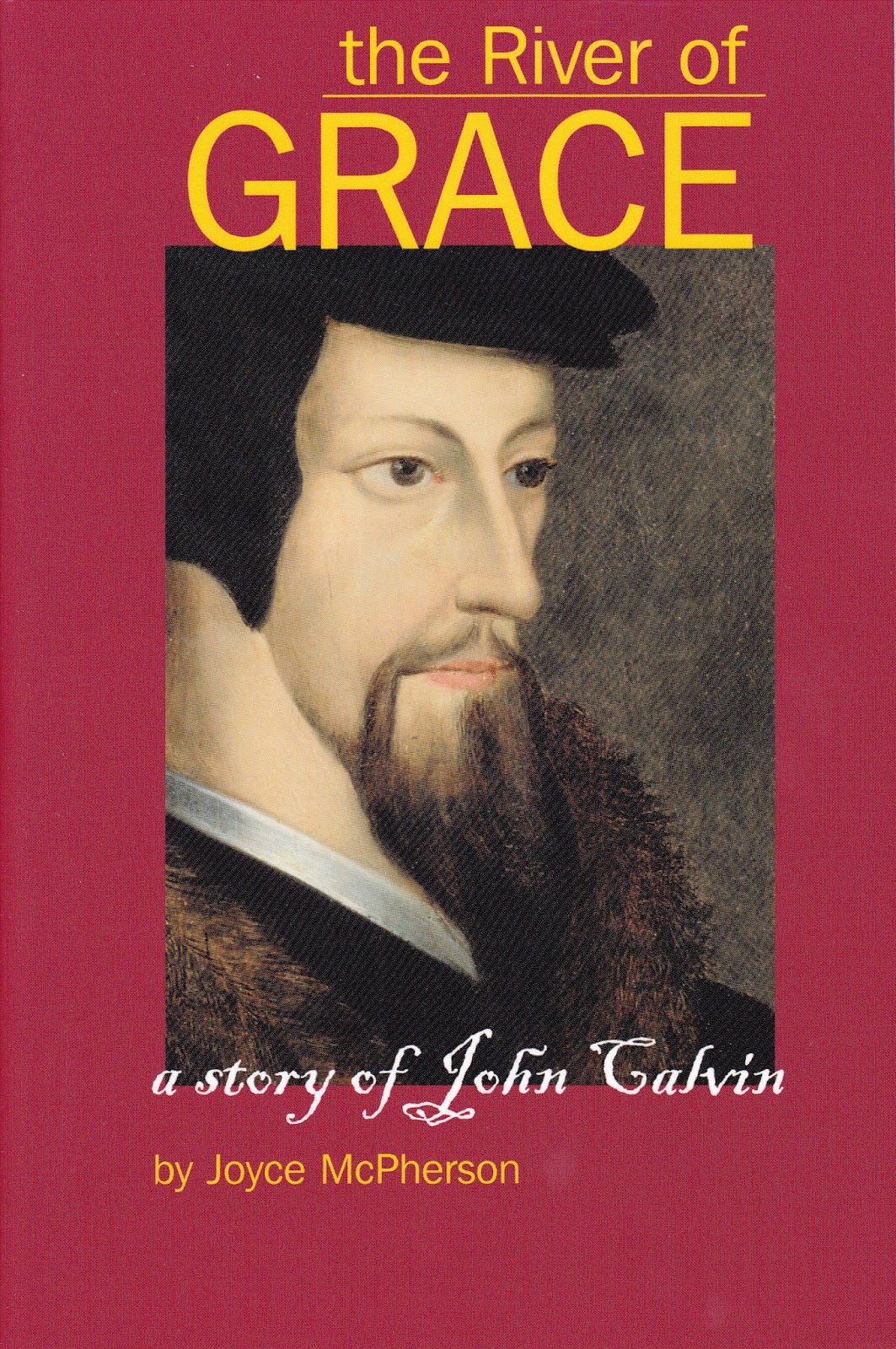
The River of Grace by Joyce McPherson 

Published by Greenleaf Press and 171 pages, this is one of the rare biographies of John Calvin written for young people. I've read a couple of the author's other books and thought they were very well written and I appreciate that McPherson brings history alive but also illustrates how Western Civilization has been influenced by the Christian worldview. I also like the quotes at the beginning of each chapter:

'Ambition deludes men so much that by its sweetness it not only intoxicates but drives them mad.'
John Calvin


Augustine: The Farmer Boy of Tagaste by P. De Zeeuw 

A short, engaging biography of Augustine of Hippo (A.D. 354-430) this little book (93 pages) would be interesting for anyone, adult or child, to learn about the wonderful story of Augustine's conversion to Christianity and the faithfulness of a mother who never gave up praying for her reprobate son. 

In the farthest corner under a fig tree he fell to his face, and panting, full of hesitation, Augustine uttered his first real prayer: "How long? Oh, how long? Tomorrow? Always tomorrow, why not right away? Why can I not put a stop to this sinful life right away?"

But listen-what was that? The garden next door was separated from him by a wall, and from behind that wall came the voice of a girl singing, "Tolle, lege," which meant "Take, read!'

...He jumped up from the ground and went to the bench...There were the Epistles of Paul, which Alypius had taken with him into the garden. Augustine picked them up, and the first words he read hit him like lightning.


Wednesday, August 26, 2015

The Spartan by Caroline Dale Snedeker


The historian Herodotus (c. 485-425 BC) in his narrative history, which records the wars between the Greeks and the Persians, gives an account of a young man named Aristodemos. Caroline Dale Snedeker has taken this brief description, fleshed it out and brought this period of ancient history vibrantly to life.
The son of Lykos, a cultured Athenian and his Spartan wife, Makaria, Aristdemos grew up in Athens, inbibing the culture, the love of beauty, the songs of Homer and his father's ideas of freedom. When he was 10 years old his father was killed in an accident and he and his mother returned to her hometown in Sparta. Here he was thrust into the rigours of a Spartan training camp, which appalled and disgusted him.

Aristodemos was placed under Leonidas, his 'ilarch,' who trained him but also offered him his friendship. As the young boy gradually learnt the ways of the Spartans, he became a respected warrior and Leonidas's closest companion.

"Thy mother loveth and honoureth the thee," remarked Leonidas. They were throwing the disk in the Dromos, where Aristodemos's skill was gradually creeping up to the record of his friend. Aristodemos paused, thoughtful, with bowed head, disk in hand.
"She loved me not when I was poor and unheeded. I think it is my victory she love the more than me."

Leonidas eventually became King of Sparta and when King Xerxes and his Persian host threatened the countries of Greece, Aristodemos went with Leonidas to defend the Pass of Thermopylae.
Originally published as The Coward of Thermopylae in 1911, the book was republished as The Spartan in 1912, and in the preface to the 1912 edition the author wrote:

The new title of the book will be found a little less misleading than the former. One must perhaps know our hero well before the "Coward of Thermopylae" can become an affectionate paradox.

Getting to know our hero Aristodemos, the only survivor of The Battle of Thermopylae, well, is the substance of this book.


Some thoughts:

The Spartan is scheduled in Year 12 of Ambleside Online and at first glance it might appear out of place at that level. Caroline Dale Snedeker wrote a number of historically accurate novels for children but this book is more than just a story set in Ancient Greece. The differences culturally and philosophically between the people of Athens and those of Sparta is skilfully shown; the splendour of the Persians and the hubris of Xerxes; the realities of Spartan training, their embracing of death and the fatalistic fear inspired by their gods are interwoven in the story.

...something in the brightness of the face, the joyous nod of the golden head, struck Leonidas with that shrewd ancient fear of the Greeks.

"Be not so openly glad, Aristodemos," he said. "Remember the signet ring of Polycrates the fortunate one, which the gods returned to him from the sea before they came to destroy him. Some things the gods will not brook, and for the too-happy man there is no escape, turn he this way or that!"


One of the strongest pictures for me was the absolute rejection of Aristodemos by his mother after the Battle of Thermopylae. Following the natural progression of a philosophical outlook to its end - in this case a mother who would curse and spurn her son who returned from battle, without knowing the circumstances, and wish him dead - was a powerful way to portray and bring the Spartan philosophy to life.
Our philosophy of life is reflected in how we live and act, and bears fruit in keeping with itself.


I really like historically based books like this to have a map but fortunately, it doesn't have any, so here's one from Wikipedia.


Monday, June 29, 2015

Books for Beginning Readers: History

This is a follow on post from Books for Beginning Readers: Nature & Science. These are books that were favourites in our home. Besides being readable for beginning readers, the stories are based on historic events and history has been an area all of my children have loved.

Step into Reading Books - these are in order of difficulty, starting from the easiest.

The Bravest Dog Ever: The True Story of Balto by Natalie Standiford. Balto carries a diphtheria vaccine to the town of Nome, in Alaska during a terrible storm in 1925.


Tut's Mummy by Judy Donnelly - from the death of Tutankhamen over three thousand years ago to the discovery of his tomb and its treasures in 1922 by English archaeologist, Howard Carter.


The Titanic Lost & Found by Judy Donnelly - after the sinking of the Titanic in 1912, the ship lay on the ocean floor for over 70 years until 1985, when it was found by 'Argo,' a specially made underwater robot, the invention of scientist Robert Ballard.


The book is a step up from Tut's Mummy & introduces paragraphs.


The Trojan Horse: How the Greeks Won the War by Emily Little - 6 short chapters. Archaeologist Heinrich Schliemann had read Homer's Iliad and believed that the city of Troy did actually exist. In 1870 he went to Turkey and began to dig...


'An I Can Read Book'


Buffalo Bill and the Pony Express by Eleanor Coerr


Based on a real character. Not much historical content but a fun read for boys especially. One of my boys knew this book inside out & we heard him narrate a chunk of it while he was asleep one night.


Sam the Minuteman by Nathaniel Benchley - a young boy's experience of the Battle of Lexington, the famous battle that marked the beginning of the American Revolution. My Aussie kids loved this and its companion book, George the Drummer Boy.


The start of the American Revolution from George the Drummer Boy's view.

We've got an older hardback copy which I couldn't place when I was looking through the other books but it was another favourite.


 Follow the Drinking Gourd: a Story of the Underground Railway by F.N. Monjo - 6 short chapters. The writing in this book is of a smaller print than any of the other books I've posted here.


Crazy Horse: Sioux Warrior by Enid Meadowcroft is more of a short chapter book but it is an interesting read for a beginner who is ready for something more than one of the shorter readers above. 11 chapters, 80 pages & large print.


The author has written three other books about American Indians in this series.


Friday, January 2, 2015

Authors for Teens - Part 1


The books by authors I've listed here are those our children enjoyed reading in their spare time when they were in their teens. An asterisk means some of my children read it before their teens or that it's suitable for a younger age level. Just be aware that this is only my opinion & even in our own family, what might have been right for one child at age 12 or 14 years didn't necessarily mean it was suitable for another at the same age.

Alistair Maclean (1922-1987)

Action, intrigue, espionage; one man against all odds, fast-paced. A number of his books have been made into films and although you wouldn’t call them great literature, they’re mostly good reads (his earlier books are better) & and his writing doesn't have the ‘romance issues’ or inapproriate material of other authors who have written books in a similar genre. Probably most suited to ages 14yrs and over, but I let my 12 year old boy read a few (*).

The Guns of Navarone *                                                                              
The Lonely Sea (a collection of short stories)                                                 
Ice Station Zebra
Santorini
Where Eagles Dare                                                                                                              
Force 10 from Navarone *
Bear Island                                                                                                                         
The River of Death                                                                                                           
The Golden Gate                                                                                                         
Golden Rendezvous *                                                                                               
Caravan to Vaccares                                                                                               
The Last Frontier                                                                                               
HMS Ulysses


John Buchan (1875-1940)

A prolific author, he also wrote historical works such as Sir Walter Scott and The Great War but is better known by far for his suspenseful thrillers such as The Thirty-Nine Steps in which he introduces the hero, Richard Hannay.  Framed for murder, Hannay embarks upon a life of espionage in the lead up to the First World War. This book and four others immediately below follow the hero's life through danger, intrigue & war and are great reads with intricate plots & interesting characters:

The Thirty-Nine Steps *
Greenmantle
Mr. Standfast
The Three Hostages
The Island of Sheep

Other adventure novels include:
Huntingtower 
John MacNab
Sick Heart River

I'd recommend starting with The Thirty-Nine Steps for a younger reader - it's not as involved as some of his others and the plot is easier to follow. I think 14 year olds & up would appreciate Buchan's other books most.
I haven't included some of his other titles that I've read & enjoyed here eg. Witchwood, as I think they're more suited to an older audience.

Regina Doman  (1970-)

Regina Doman has written a series of modern day fairy tales for teens based some original fairy tales eg. Snow White, Sleeping Beauty & Ali Baba which my daughter started reading when she was about 16. The author's website gives a review of the books and has some free chapters online. I think they are done well, particularly the first three, Shadow of the Bear, Black as Night, & Waking Rose (it helps if you know the original tales) but there are some themes you should be aware of before giving them as free reads.

"The more truly we can see life as a fairytale, the more clearly the tale resolves itself into a war with the Dragon who is wasting fairyland." - G.K. Chesterton.

On the theme of fairy tales, a book we've all enjoyed is Beauty by Robin McKinley, a wonderful re-telling of Beauty & the Beast. This is suitable for younger readers, around 12 years & up.

Rosemary Sutcliff (1920-1992)

At two years of age Rosemary Sutcliff contracted Still's Disease (a type of Juvenile Rheumatoid Arthritis) and spent most of her life in wheelchair. In her early years she had to lie on back and during this time she was read to by her mother - books by Dickens, Thackeray, Trollope, and Greek & Roman legends.

She was a late reader and due to her condition was mostly educated at home. At the age of 14 years she began her training in the art of miniature painting; published her first children's book in 1950, and afterwards devoted her time to writing children's historical novels.


One of our favourite authors, Rosemary Sutcliff has written some wonderful historical fiction. Many of her books are suitable for younger readers. Some favourites which our children read for themselves around the ages of 12 years and up:

The Eagle of the Ninth *
The Lantern Bearers
The Silver Branch
Outcast *
Dawn Wind *
Knight's Fee
Frontier Wolf

The following three are for more mature readers:

Bonnie Dundee -
Hugh Herriott was a young lad who had grown up in a Scottish Covenanter family. When he witnesses an attack on Government troops in which his older brother kills a boy not much older than Hugh himself, he is taken by Government troops and brought before Bloody Claver'se (Bonnie Dundee). Claverhouse questions him and then sets him free but Hugh cannot forget the ugly attack in which the young boy was killed: 

I wanted no more to do with men and the world of men ever again. The pull of two loyalties within me was over and done with, and there was some relief in that. I knew now that I was like Montrose: that I was no Covenanter nor ever could be. But oh, the grief was on me was sore.

An insightful book that sensitively portrays Jacobite Scotland in the seventeenth century.


'To the Lords of Convention 'twas Claver'se who spoke,
 'Ere the King's crown shall fall there are crowns to be broke,
So let each Cavalier who loves honour and me, 
Come follow the bonnet of Bonny Dundee!'
Walter Scott

Lady in Waiting  - Bess Throckmorton, Maid of Honour to Queen Elizabeth I, is secretly married to the ambitious young Walter Ralegh. A delightful historical novel of Elizabethan times.


Song for a Dark Queen -
A fictionalised account of Queen Boudica of the Iceni and the Roman invaders.


Queen Boudica by John Opie


A short biography of the author is here.


Sir Arthur Conan Doyle (1859-1930)

* Sir Nigel - set in the earlier part of the Hundred Year's War  
* The White Company - an exciting adventure also set during the Hundred Year's War.

These two books are companions to each other but can be read in any order. The White Company was probably the favourite out of the two for us. The author's books are in the public domain.


* Study in Scarlet - Doyle's detective mystery where he first introduces Sherlock Holmes and Dr. Watson. Kindle version here.

* The Adventures of Sherlock Holmes

* The Hound of the Baskervilles


G.K. Chesterton (1874-1936)

Most of my children loved Chesterton's quirky writing but one of the boys just didn't take to him at all. They are all available free online.


Father Brown series 
The Man Who was Thursday
Club of Queer Trades
The Napoleon of Nottinghill


Friday, August 29, 2014

Australian Historical Fiction for Primary Age Children - Verity of Sydney Town by Ruth C. Williams


Verity of Sydney Town, an historical novel, was first published in 1950 by a Sydney based author and was awarded Children's Book of the Year in 1957. It is set in New South Wales during the period of Governor Macquarie's time in office (early 1800's) against a backdrop of pioneering farmers, bushrangers and convicts, and it is an interesting and lively account of the times. 


A strange little place...this Sydney Town, built as it was round a cove which the natives called Warrang; neither entirely a seaport nor a country town, nor a convict settlement, nor a military outpost, and yet, in appearance, all these things in part. Covered by a dome of blue sky, flanked by a glorious harbour and the mystery of lonely headlands, it had a beauty of its own; and yet the town itself --despite the orderliness and seemliness insisted upon by His Excellency, despite neat fences and whitewash, flag-stones and clean-swept paths -- retained an appearance of raggedness, like a pretty lass in a frayed petticoat.


Verity is a twelve year old girl whose father, a ship's captain, has been lost at sea. The young girl is put under the care of unsympathetic guardians in Sydney Town who, believing the captain to be dead, eventually send her out west to live with a farmer and his family; charitable people who knew her father and wanted to show kindness to his daughter.
Verity settles into her new life and shares in the hard work of the farm. She is befriended by Humphrey, the farmer's son and Slippery Britter, a young, cheerful, and warm-hearted ex-convict who works at the farm.

After Verity has been living at the farm for some time, news comes that the Hawkesbury River is in flood. The farmer and his wife, fearing for the welfare of their married daughter and her baby, leave Verity and Humphrey in Britter's care and travel to the Hawkesbury region to bring them to safety.
While they are gone, the farm receives some unwelcome visitors. A group of bushrangers, one of them an ex-convict who used to work at the farm, break in and threaten the lives of the two children. Britter's bravery and quick thinking rescues them and the three of them run away into the night but the bushrangers are in hot pursuit and Britter is wounded. Humphrey's intervention saves him from being murdered and the three of them stagger away in the dark and rain to a place of safety.

Disappointment awaits them when they arrive at the closest habitation only to find it deserted and the route to Windsor cut off by flood. Britter suggests that they go back home as the farmer would return before long and the bushrangers would be quick in making their escape. They return to the farm to find other strangers there and the homestead badly damaged by fire.

There is an episode in the book where the two children decide to 'reform' their friend Britter and ask him to promise never to resort to stealing again - the crime for which he was transported to Australia in the first place. He was a little resentful at the time at the presumption he was still a thief, but the tables were later turned when they arrived at the deserted town. Ravenous with hunger, Humphrey suggests forcing a window and helping themselves to some food but Britter would have none of it.

'But I am so hungry!' Humphrey tried again, on a plaintive note.

'So was I when I stole the plum-pudding,' replied Britter, quite unmoved. 'But they sent me to Botany Bay for it. No you don't! You don't catch me stealing nothin'. You wanted to reform me, didn't you? Well, you has, see! And a reformed felon has to be as careful of his reputation as any dainty miss in her first season. Why, buck up, man! A little hunger won't hurt you. And I ought to know!


Tighten your belt, lad, and shut your mouth! And when you are a man remember this day and start a movement for every judge to try a little fasting himself before condemning any man to death for stealing a bite of food.'

The book would probably be most enjoyed by children around 10 to 12 years of age and both boys and girls would appreciate the tale, so don't be put off by the title. It is a story centred around a young girl but the author allows other characters to also take centre stage and in so doing has broadened the story's appeal.

Governor Macquarie is portrayed as a humane man who endeavoured to deal justly with the convicts. Some background information on his time in office is given here.

The book would fit well chronologically in Term 1 of Ambleside Online Year 5 (early 1800's).