Showing posts with label History. Show all posts

Monday, September 7, 2015

Church History for Children

We've used these books to introduce some Church History to our children when they were about 8  years old and up. Some of them I read aloud but they are all suitable for children to read on their own. Moozle (10 years old) has just finished going through all the Louise Vernon titles again recently. Vernon's books are fictional but they are mostly set in the time of the Reformation and introduce the great events and people of Church History in a way children can understand and relate to. There are twelve books that I know of, illustrated every now and then with black ink, and they are on average about 125 pages in length. Here are a few that have been well read in our home:

Ink on His Fingers


An exciting story centred around the printing of the first Bible after Johann Gutenberg's invention of moveable type in the 1450's.


The Man Who Laid the Egg

The story of Desiderius Erasmus (1466-1536) who has been called the intellectual father of the Reformation, seen through the eyes of a young apprentice.

'Erasmus laid the egg, and Luther hatched it.'


Thunderstorm in the Church

Martin Luther seen through the eyes of his son. 'Through Han's eyes you will learn to know Martin Luther - not only as the great Reformer-preacher, but also as a father with a sense of humor and as a friend.'


A Heart Strangely Warmed

Young Robert Upton was peddling his father's goods when he meets John Wesley, a fiery little man who is preaching on the streets of London. Heend Wesley's meetings and gradually Robert begins to understand Wesley's message and feels like Wesley described in his Journal below, that his heart is strangely warmed.'

In the evening I went very unwillingly to a society in Aldersgate Street, where one was reading Luther’s preface to the Epistle to the Romans. About a quarter before nine, while he was describing the change which God works in the heart through faith in Christ, I felt my heart strangely warmed. I felt I did trust in Christ, Christ alone, for salvation; and an assurance was given me that He had taken away my sins, even mine, and saved me from the law of sin and death.


Other books by Louise Vernon which are all good and cover some lesser known aspects of Church History are:

The Beggar's Bible (JohnWycliffe)
The Bible Smuggler (William Tyndale)
 Key to the Prison (George Fox & the Quakers)
The King's Book ( The King James Bible translation)
Peter & the Pilgrims (English Separatists & Pilgrims)
Night Preacher (Menno Simons)
The Secret Church (Anabaptists)
Strangers in the Land (Huguenots)
And one which we haven't read, and don't have - Doctor in Rags (Paracelsus & the Hutterites) 


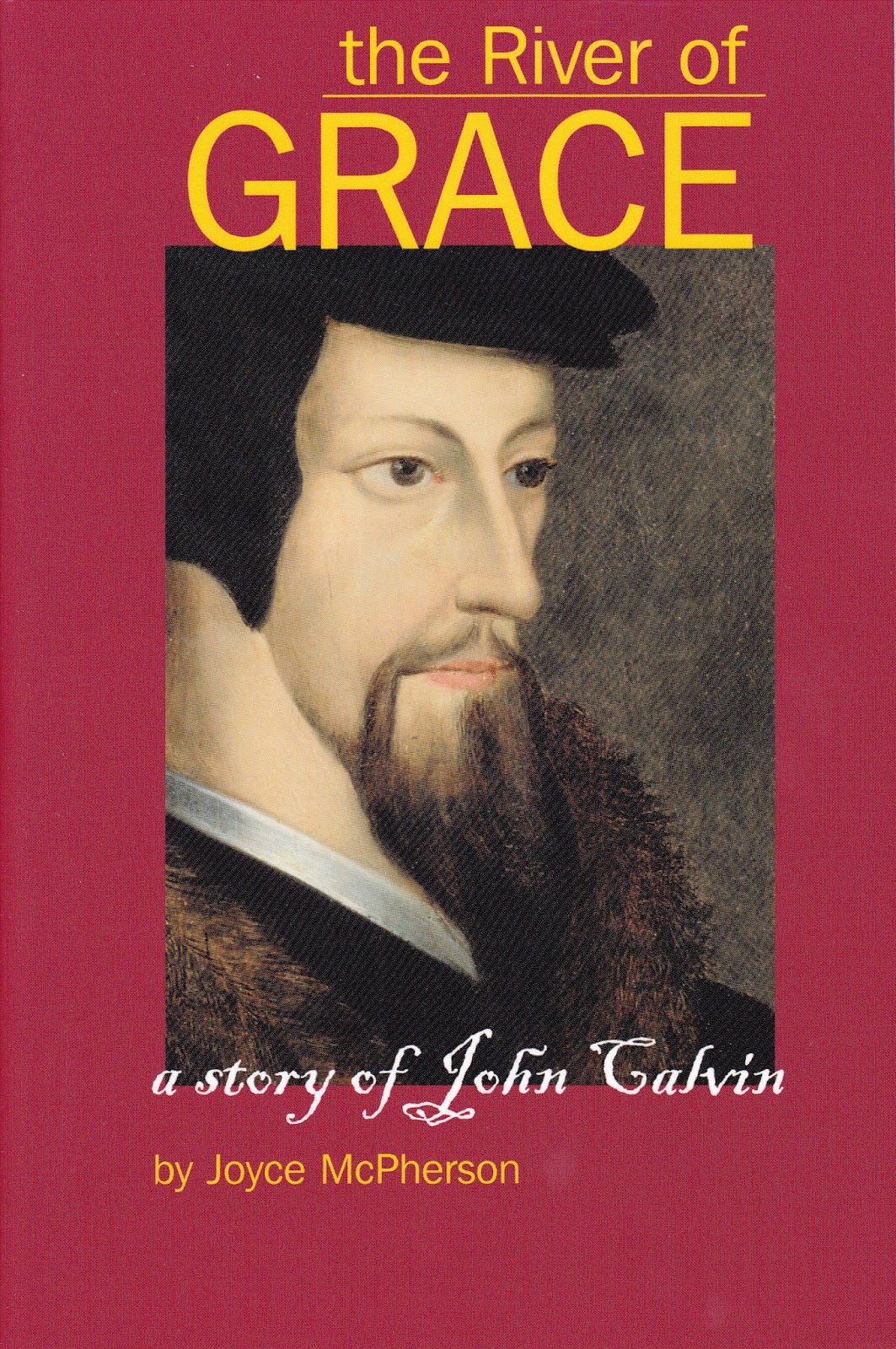
The River of Grace by Joyce McPherson 

Published by Greenleaf Press and 171 pages, this is one of the rare biographies of John Calvin written for young people. I've read a couple of the author's other books and thought they were very well written and I appreciate that McPherson brings history alive but also illustrates how Western Civilization has been influenced by the Christian worldview. I also like the quotes at the beginning of each chapter:

'Ambition deludes men so much that by its sweetness it not only intoxicates but drives them mad.'
John Calvin


Augustine: The Farmer Boy of Tagaste by P. De Zeeuw 

A short, engaging biography of Augustine of Hippo (A.D. 354-430) this little book (93 pages) would be interesting for anyone, adult or child, to learn about the wonderful story of Augustine's conversion to Christianity and the faithfulness of a mother who never gave up praying for her reprobate son. 

In the farthest corner under a fig tree he fell to his face, and panting, full of hesitation, Augustine uttered his first real prayer: "How long? Oh, how long? Tomorrow? Always tomorrow, why not right away? Why can I not put a stop to this sinful life right away?"

But listen-what was that? The garden next door was separated from him by a wall, and from behind that wall came the voice of a girl singing, "Tolle, lege," which meant "Take, read!'

...He jumped up from the ground and went to the bench...There were the Epistles of Paul, which Alypius had taken with him into the garden. Augustine picked them up, and the first words he read hit him like lightning.


Wednesday, August 26, 2015

The Spartan by Caroline Dale Snedeker


The historian Herodotus (c. 485-425 BC) in his narrative history, which records the wars between the Greeks and the Persians, gives an account of a young man named Aristodemos. Caroline Dale Snedeker has taken this brief description, fleshed it out and brought this period of ancient history vibrantly to life.
The son of Lykos, a cultured Athenian and his Spartan wife, Makaria, Aristdemos grew up in Athens, inbibing the culture, the love of beauty, the songs of Homer and his father's ideas of freedom. When he was 10 years old his father was killed in an accident and he and his mother returned to her hometown in Sparta. Here he was thrust into the rigours of a Spartan training camp, which appalled and disgusted him.

Aristodemos was placed under Leonidas, his 'ilarch,' who trained him but also offered him his friendship. As the young boy gradually learnt the ways of the Spartans, he became a respected warrior and Leonidas's closest companion.

"Thy mother loveth and honoureth the thee," remarked Leonidas. They were throwing the disk in the Dromos, where Aristodemos's skill was gradually creeping up to the record of his friend. Aristodemos paused, thoughtful, with bowed head, disk in hand.
"She loved me not when I was poor and unheeded. I think it is my victory she love the more than me."

Leonidas eventually became King of Sparta and when King Xerxes and his Persian host threatened the countries of Greece, Aristodemos went with Leonidas to defend the Pass of Thermopylae.
Originally published as The Coward of Thermopylae in 1911, the book was republished as The Spartan in 1912, and in the preface to the 1912 edition the author wrote:

The new title of the book will be found a little less misleading than the former. One must perhaps know our hero well before the "Coward of Thermopylae" can become an affectionate paradox.

Getting to know our hero Aristodemos, the only survivor of The Battle of Thermopylae, well, is the substance of this book.


Some thoughts:

The Spartan is scheduled in Year 12 of Ambleside Online and at first glance it might appear out of place at that level. Caroline Dale Snedeker wrote a number of historically accurate novels for children but this book is more than just a story set in Ancient Greece. The differences culturally and philosophically between the people of Athens and those of Sparta is skilfully shown; the splendour of the Persians and the hubris of Xerxes; the realities of Spartan training, their embracing of death and the fatalistic fear inspired by their gods are interwoven in the story.

...something in the brightness of the face, the joyous nod of the golden head, struck Leonidas with that shrewd ancient fear of the Greeks.

"Be not so openly glad, Aristodemos," he said. "Remember the signet ring of Polycrates the fortunate one, which the gods returned to him from the sea before they came to destroy him. Some things the gods will not brook, and for the too-happy man there is no escape, turn he this way or that!"


One of the strongest pictures for me was the absolute rejection of Aristodemos by his mother after the Battle of Thermopylae. Following the natural progression of a philosophical outlook to its end - in this case a mother who would curse and spurn her son who returned from battle, without knowing the circumstances, and wish him dead - was a powerful way to portray and bring the Spartan philosophy to life.
Our philosophy of life is reflected in how we live and act, and bears fruit in keeping with itself.


I really like historically based books like this to have a map but fortunately, it doesn't have any, so here's one from Wikipedia.


Monday, June 29, 2015

Books for Beginning Readers: History

This is a follow on post from Books for Beginning Readers: Nature & Science. These are books that were favourites in our home. Besides being readable for beginning readers, the stories are based on historic events and history has been an area all of my children have loved.

Step into Reading Books - these are in order of difficulty, starting from the easiest.

The Bravest Dog Ever: The True Story of Balto by Natalie Standiford. Balto carries a diphtheria vaccine to the town of Nome, in Alaska during a terrible storm in 1925.


Tut's Mummy by Judy Donnelly - from the death of Tutankhamen over three thousand years ago to the discovery of his tomb and its treasures in 1922 by English archaeologist, Howard Carter.


The Titanic Lost & Found by Judy Donnelly - after the sinking of the Titanic in 1912, the ship lay on the ocean floor for over 70 years until 1985, when it was found by 'Argo,' a specially made underwater robot, the invention of scientist Robert Ballard.


The book is a step up from Tut's Mummy & introduces paragraphs.


The Trojan Horse: How the Greeks Won the War by Emily Little - 6 short chapters. Archaeologist Heinrich Schliemann had read Homer's Iliad and believed that the city of Troy did actually exist. In 1870 he went to Turkey and began to dig...


'An I Can Read Book'


Buffalo Bill and the Pony Express by Eleanor Coerr


Based on a real character. Not much historical content but a fun read for boys especially. One of my boys knew this book inside out & we heard him narrate a chunk of it while he was asleep one night.


Sam the Minuteman by Nathaniel Benchley - a young boy's experience of the Battle of Lexington, the famous battle that marked the beginning of the American Revolution. My Aussie kids loved this and its companion book, George the Drummer Boy.


The start of the American Revolution from George the Drummer Boy's view.

We've got an older hardback copy which I couldn't place when I was looking through the other books but it was another favourite.


 Follow the Drinking Gourd: a Story of the Underground Railway by F.N. Monjo - 6 short chapters. The writing in this book is of a smaller print than any of the other books I've posted here.


Crazy Horse: Sioux Warrior by Enid Meadowcroft is more of a short chapter book but it is an interesting read for a beginner who is ready for something more than one of the shorter readers above. 11 chapters, 80 pages & large print.


The author has written three other books about American Indians in this series.


Tuesday, June 3, 2014

Presenting Miss Jane Austen


My introduction to Jane Austen didn't occur until I was an adult. Even my husband had read Pride and Prejudice before I had. It was a different story for my two older girls. When JJ was about 12 years old, she was bemoaning the fact that there was nothing to read, even though we have wall to wall books, and BB upon hearing this, suggested she read Pride and Prejudice. She wasn't keen at first because the title suggested to her some sort of morality tale about avoiding pride but BB set her right and told her it was one of his favourite books.
Zana was fortunate in that the BBC production of Pride & Prejudice came out when she was at an age to enjoy it and that was her first introduction to Jane Austen.
I probably have good reason to dislike this movie. A number of years ago six of our seven children became sick with chicken pox. I was house bound for about six weeks by the time it went through everyone. The 13 and 15 year olds were absolutely miserable and one night Zana, the younger one, came out of her room crying because she felt so terrible. We were just about to go to bed and I didn't know what to do with her, until BB suggested that I watch P & P with her to help take her mind off her misery. Six hours later, I felt disgusting but Zana was a bit better so we both went to bed.
When she was about 14 years old I discovered Presenting Miss Jane Austen by May Lamberton Becker, which was originally written in 1952 and re-published by Bethlehem Books in 2006. By this time she'd read and re-read just about everything Jane Austen had written but this biography, written for ages 12 and up,  was another link to Jane Austen's world and she found it very interesting and enjoyable.


Miss Becker's biography gives us a lively and intimate account of Jane's childhood, her closely knit family and the literary atmosphere that enveloped them and which was such an influential part of her life.

Through poetry new and old Jane's father guided her reading; better still, he read aloud to the family - history, travel books, lively essays...

The whole family read The Vicar of Wakefield...whose people were spoken of in the family as if they lived just around the corner - as Miss Jane Austen's people are spoken of now.

Quotations from Jane Austen's correspondence with her beloved sister Cassandra and other family members give us an insight into her personal life and the background that formed the fabric for her novels. Her immediate family were as familiar with the various characters in her writing as though they had been real people.

For the people in this blessed book did not come to life on the first page and dissolve on the last. They were alive before Chapter One, and they went on living after the book left them, and Jane knew very well what they were doing, before and after. She knew what Mr. Collins was like in his clumsy school days, long before he made his pompous, peerless proposal to Elizabeth, and where he had picked up, on the way towards the patronage of Lady Catherine de Bourgh, that, "mixture of pride and obsequiousness, self-importance and humility" that makes him so great a comic character. I am convinced that she knew what Lady Catherine de Bourgh looked like in her perambulation, though she spares us that grim sight.


No one outside of her family knew of her writing ability, let alone that she had already published a book, until her brother let the cat out of the bag and her secret was uncovered. Her nephew, James Edward who had read and enjoyed the earlier novels, unaware that his Aunt was the author, wrote to her when the secret was revealed:

No words can express, my dear Aunt, my surprise 
Or make you conceive how I opened my eyes, 
Like a pig Butcher Pile has just struck with his knife, 
When I heard for the very first time in my life 
That I had the honour to have a relation 
Whose works were dispersed through the whole of the nation.

This book is a perfect introduction for anyone who is interested in Jane Austen's background whether they've read her novels or not. The age 12 recommendation is certainly suitable content wise but some children might enjoy it more when they are around 14 years of age and have a bit more maturity to appreciate the minutiae the author includes.