Showing posts with label Plutarch. Show all posts

Wednesday, March 18, 2015

Playing with Plutarch with the artful aid of alliteration


After I had read our Plutarch lesson & Bengy and Moozle had taken turns narrating sections, I had them both write out a number of words starting with the letter 't.'
'T' was the obvious letter to use as we're going through the life of Timoleon and just about everyone involved in the narrative has a name starting with that letter.
Then I asked them to write a short paragraph or verse relating to our reading using alliteration.
This was just a quick & rough exercise but they had a bit of fun.
Alliteration is enjoyable for a younger child to try - it's one of the more obvious and easiest poetic devices to use.

Bengy wrote:

Trustworthy Timoleon trusted
Tumultuous, tyrannical Timophanes
Who had a tendency to terrify
Tremendously true citizens
But Timophanes turned traitor
And Timoleon tried to tell him
To give his crown to the people
But tumultuous, tyrannical Timophanes
Laughed the trusted warnings aside
And so Timoleon, with tremendous tenacity
Therein killed Timophanes!


This is Moozle's (unedited) version where spelling goes out the window:

Timoleon tried to peswade his brother Timophanes to stop his tyranicall tyranny and thinking that his traterus tyranny would sucsed. He would be tyrannicly traiterus to the people, Timoleon said.
He already had a tyrannical aditude towards the peoples and it would not turn out well.


Edited copy:

Timoloeon tried to persuade his brother Timophanes to stop his tyrannical tyranny and thinking that his traitorous tyranny would succeed.
He would be tyrannically traitorous to the people, Timoleon said.
He already had a tyrannical attitude towards the peoples and it would not turn out well.


Tuesday, August 5, 2014

Ambleside Online Year 3 - Shakespeare, Plutarch & Poetic Narration


A few months ago I shared some of Moozle's written narrations inspired by Plutarch. Since then she has continued to do a written narration once or twice a week and has branched out a little from the letter form she started with.
The  first one here is still in letter form but was inspired after our weekly reading and listening to Twelfth Night, which we finished about six weeks ago.


This one was a 'news report' she wrote after we'd read a lesson from Plutarch's life of Crassus. Some poetic license was taken in the 'Consul Spiro Maximus Nero' addition - Spiro and various derivatives of said name have been popping up in all of her Plutarch narrations, regardless of whether the characters are Roman or Greek.


This one was done this morning. She's been keen to do a poetic narration and she asked if she could do one after reading a chapter of Our Island Story. I thought she'd be so intent on making it rhyme that it wouldn't make much sense but I was surprised when she came up with this


I shouldn't have been surprised because she's been listening to poetry for years and absorbing rhythm, rhyme and the beauty of words and that should translate into her writing at some point but I wasn't expecting it at this stage. Just as I wasn't expecting her to get anything much from Plutarch, either.

The reading of poetry will:

 '...accustom him to the delicate rendering of shades of meaning, and especially to make him aware that words are beautiful in themselves, that they are a source of pleasure, and are worthy of our honour.'

Home Education by Charlotte Mason

Sunday, June 22, 2014

Mother Culture

Some quotes and thoughts that have stirred my heart or encouraged me in some way this week:

Uniqueness


'Everyone on this earth should believe, amid whatever madness or moral failure, that his life and temperament have some object on the earth. Everyone on the earth should believe that he has something to give the world which cannot otherwise be given.'


I keep a prayer notebook. For each day of the month I have a list of people I pray for. I also have a couple of pages set aside for my immediate family with ongoing prayer reminders and scriptures I pray over each of them and I'd neglected this notebook in recent months. I was still praying but some people slipped through the cracks because I didn't think of them in the busyness of life. I read these words and was stirred to be more faithful in prayer:

'If you are not getting the hundredfold more, not getting insight into God's Word, then start praying for your friends, enter into the ministry of the interior. "The Lord turned the captivity of Job when he prayed for his friends." Job 42:10 Wherever God puts you in circumstances, pray immediately...Pray for your friends now; pray for those with whom you come in contact now...'

Oswald Chambers

After reading the words by Chambers above I also thought that I should be putting feet on my prayers. I decided I'd act upon what the Lord put on my heart that day - pray and then follow it up with an action, however small. For me that meant an email, a phone call, a visit, some text messages, a letter, a card.

'As for me, far be it from me that I should sin against the Lord by failing to pray for you.' 1 Samuel 12:23

My intention: to put feet on at least one of the prayers I pray today. 


A picture of a friendship between two couples inspired me to have a large-spirit mentality in my relationships:

'In the ripened Indian summer weather, those two once again choose us. In circumstances where smaller spirits might let envy corrode liking, they declare their generous pleasure in our company and our good luck...

We have been invited into their lives, from which we will never be evicted or evict ourselves.'

Crossing to Safety by Wallace Stegner


Sometimes my children have not appreciated reading and memorising Poetry. "When are we ever going to use this? What's the point?"
Well, one day it might save your life.
We've just completed Plutarch's life of Nicias. The Syracrusans had defeated the Athenians and the Athenian prisoners were sent to the quarries or into slavery and their commanders executed. But there were some who gained their freedom in an unusual way:

'Several were saved for the sake of Euripides, whose poetry, it appears, was in request among the Sicilians more than among any of the settlers out of Greece. And when any travelers arrived that could tell them some passage, or give them any specimen of his verses, they were delighted to be able to communicate them to one another. Many of the captives who got safe back to Athens are said, after they reached home, to have gone and made their acknowledgments to Euripides, relating how that some of them had been released from their slavery by teaching what they could remember of his poems, and others, when straggling after the fight, been relieved with meat and drink for repeating some of his lyrics. Nor need this be any wonder, for it is told that a ship of Caunus fleeing into one of their harbors for protection, pursued by pirates, was not received, but forced back, till one asked if they knew any of Euripides’s verses, and on their saying they did, they were admitted, and their ship brought into harbour.'

 We teach Poetry because it nourishes the soul and here it had the added benefit of preserving it.


Thursday, April 3, 2014

Plutarch Narrations from a 9 Year Old

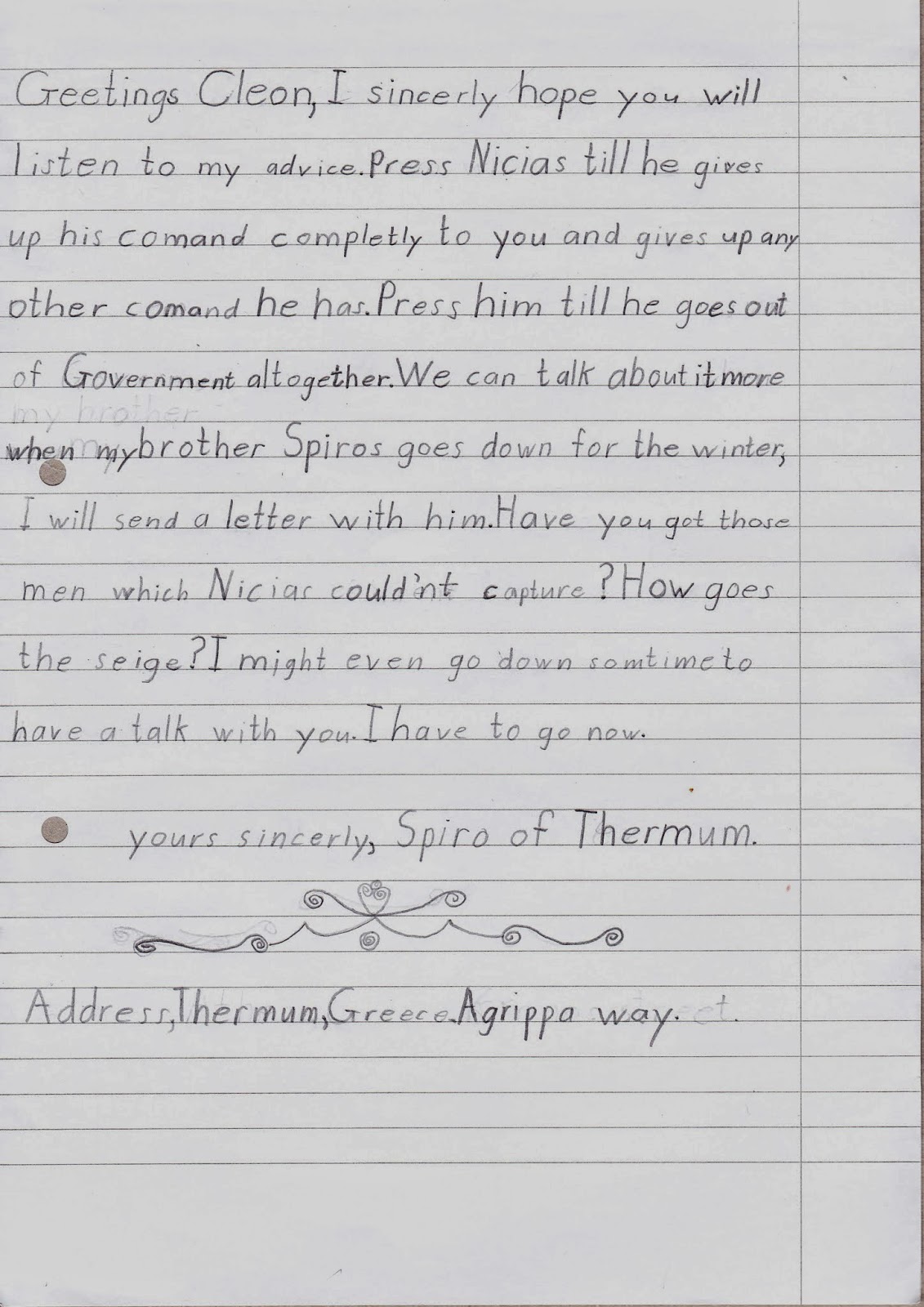
Moozle has been listening in on our Plutarch readings since she was about 7 years old and has often surprised me by jumping in and giving her version of the story. I've just started her on written narrations this week by asking her to write a sentence on something she's read or I've read aloud to her. She wrote a couple of sentences after I read Our Island Story but she really wanted to write a narration based on Plutarch's life of Nicias which we started a few weeks ago. One of her brothers chose to write his narration from the viewpoint of Cleon, the antagonist, and Moozle decided she'd do something similar:


Yesterday I had to go out for a while and when I returned she'd done the work I'd asked her to do under the supervision of one of my older children who was home holding the fort and then she produced three more narrations she decided to write while I was out. (Her enthusiasm was partly because I said she could write in a lecture notepad...)
Last night she showed them to her dad and he read them aloud with a dramatic flourish (keeping the niaces and afears etc. intact).


Today she was still on a roll and came up with this:


We take the child to the living sources of history - a child of seven is fully able to comprehend Plutarch, in Plutarch's own words (translated), without any diluting and with little explanation.
Charlotte Mason, Volume II 


Tuesday, February 18, 2014

Wednesday with Words - Plutarch

We've been reading through Plutarch's life of Quintus Fabius Maximus, learning some things about his character and drawing lessons from his life.
Fabius was slow and steady, a plodder, a characteristic that was not appreciated by his next in command, the impulsive and arrogant Lucius Minucius (love that name!).

So, basically, Fabius was called to Rome and in his absence Minucius took matters into his own hands and attacked Hannibal. Instead of being punished, Minucius was elevated by those opposed to the rule of Fabius to a position of equal authority with Fabius and continued in his rash behaviour, despising the advice of the older man. Hannibal took advantage of the rift and cunningly lured Minucius into a battle:

When, therefore, (Fabius) saw the army of Minucius encompassed by the enemy, and that by their countenance and shifting their ground, they appeared more disposed to flight than to resistance, with a great sigh, striking his hand upon his thigh, he said to those about him, "O Hercules! how much sooner than I expected, though later than he seemed to desire, hath Minucius destroyed himself!"


Fabius's response to the younger man's rashness and flouting of authority was:

"We must make haste to rescue Minucius, who is a valiant man, and a lover of his country; and if he hath been too forward to engage the enemy, at another time we will tell him of it."

Magnanimous, I'd call that.

Hannibal, seeing so sudden a change of affairs, and Fabius, beyond the force of his age, opening his way through the ranks up the hill-side, that he might join Minucius, warily forbore, sounded a retreat, and drew off his men into their camp...

Fabius, after his men had picked up the spoils of the field, retired to his own camp, without saying any harsh or reproachful thing to his colleague...

The man who has understanding holds his tongue.
Proverbs 11:12

Minucius learnt a valuable lesson that day. He came to an understanding of authority and submission and that the race isn't always to the swift. Gathering his army around him he said these words to his men:

"To conduct great matters and never commit a fault is above the force of human nature; but to learn and improve by the faults we have committed, is that which becomes a good and sensible man. Some reasons I may have to accuse fortune, but I have many more to thank her; for in a few hours she hath cured a long mistake, and taught me that I am not the man who should command others, but have need of another to command me; and that we are not to contend for victory over those to whom it is our advantage to yield."

When pride comes then comes disgrace, but with humility comes wisdom. 
Proverbs 11:2

Minucius's words got me thinking about churches and the problems that result when we get this authority and yielding wrong. I've seen lots of people just drift away or go off and do their own thing because they couldn't have others 'command' them - I'm not talking about bad or abusive leadership, but a general unwillingness to yield to anyone but themselves.
Just as Minucius disregarded and despised the leadership of a man he thought was too slow, mistaking circumspection for cowardice, we can chafe under the leadership of someone who isn't doing things the way we think they should be done or in the time frame we'd prefer.

For all those who exalt themselves will be humbled, and those who humble themselves will be exalted. Matthew 23:12

 Until we learn how to be under authority, we're not going to be able to handle being in authority.