Showing posts with label Ambleside Year 4. Show all posts

Friday, September 11, 2015

Madame How & Lady Why: Chapter 7 - The Chalk-Carts

Chalk-carts, like mice, and dead leaves, and most other matters in the universe are very curious and odd things in the eyes of wise and reasonable people. 

The White Cliffs of Dover

I couldn't find a definition of 'chalk-carts' anywhere although it's obvious Kingsley was referring to the carts that carried chalk from the area where it was cut. From what I've read (here, for example) it appears the carts were part of a horse-drawn industrial tramway, something that was introduced at the beginning of the nineteenth century. This chapter was fascinating once I understood the gist of what Kingsley was getting, at which wasn't obvious to me until after I'd done some digging around.

Come, let us find out something about the chalk before we talk about the caves. The chalk is here, and the caves are not; and "Learn from the thing that lies nearest you" is as good a rule as "Do the duty which lies nearest you."


Chalk, limestone and marble are all forms of calcium carbonate. Chalk and limestone are formed in marine environments while marble is metamorphosed limestone.
This page explains the difference between limestone & marble.
Marl - a mixture of clay and calcium carbonate.

Many of these (chalk) pits are located near farms and settlements where one principal use of the chalk was for the production of lime which was used to ‘fertilise’ or ‘lighten’ heavier clay soils and also to improve drainage and make it more easy to cultivate.


The South Downs area of England is a series of chalk hills in the Hampshire, East Sussex, West Sussex counties. The chalk landscape acts like a giant sponge, and stores water. A huge underground reservoir provides fresh drinking water for over 1 million people living in the area.

Karst Landscape - Kingsley didn't use this phrase probably because it wasn't in use until the late nineteenth century, but it refers to a limestone region where most or all of the drainage is by underground channels and where erosion has produced fissures, sinkholes, underground streams, and caverns. Some photos and more information here.
I've travelled across the Nullarbor Plain many times but it was only when I was reading though Madame How & Lady Why that I discovered that it is the world's largest limestone karst.


Page 126 - The 'silver Itchen' - one of the most famous chalk streams of Hampshire in England which attracts anglers from all over the world.


Page 126 - invisible chalk  in the water causes it to be 'hard.' A written narration from 10 year old Moozle:

 "Chalk is many different things. Limestone is a harder form of chalk, and marble is chalk heated up. There is lots of chalk in England, the White cliffs of Dover are made of chalk, and lots of other things are made of chalk, not just in England, but in some other countries.  The chalk runs out of caves made by the water in little streams, and thus deposits it in the rivers. If you drink water out of one of these rivers, it’ll taste kind of hard. That’s the chalk in the river that’s making it taste hard." 

Page 130 - Caves

Cave fomations (Speleothems) - some good photos here of Jenolan Caves in NSW.

How Stalactites & Stalagmites form - stalaCtites (form on the Ceiling) and stalaGmites (form on the Ground)

We've done this experiment a few times with varying degrees of success: Make stalactites & stalagmites.

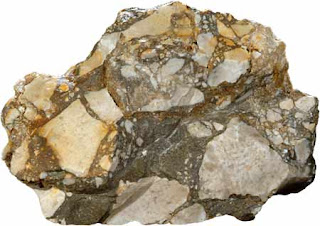


Page 131: Breccia (Italian) - rock consisting of angular fragments cemented together in a matrix.


http://flexiblelearning.auckland.ac.nz/rocks_minerals/rocks/breccia.html


Page 132: Sink hole - a basin in limestone areas down which water disappears. Other names include swallow hole, swallet or doline.

 
 Water Sinks...North Yorkshire, UK


Page 135 - the dropping-well at Knaresborough showing various articles in various stages of petrification. It will take about 3 to 5 months to petrify a teddy bear:


https://commons.wikimedia.org/wiki/File:Mother_Shipton's_cave_Knaresborough_-_geograph.org.uk_-_436482.jpg


Pg 135 - the Proteus or cave salamander. Photos and descriptions here.


Lake Cerknisko (Cercnika, Czirknitz) - the lake that vanishes. Found on a karst landscape in Slovenia


See The Mysterious Lake Cerknica - just beautiful!
And some more photos of the lake.

Page 136 - Mammoth Cave in Kentucky, USA


https://commons.wikimedia.org/wiki/File:Mammoth_Cave_National_Park_001.jpg


Page 137 - Caripe, Venezeula.

'In Humboldt's Footsteps' - The Guacharo Cave
Another name for the Guacharo bird is the oilbird - Kingsley mentions that 'The Indians kill and eat them for their fat.'
Some more information on the birds here
Wonderful gallery of photos of these birds here.



Thursday, September 3, 2015

Australian Natural History: Monarch of the Western Skies by C.K.Thompson (1946)


Monarch of the Western Skies was the first book written by C.K. Thompson that we owned. I came across it at a secondhand shop more than ten years ago and picked it up not knowing anything about the author but as it cost less than a dollar, I thought it was worth trying. It became my eight year old boy's favourite book for a long time and was also enjoyed by all the other children. Since then we've had the pleasure of reading some of his other books and I don't hesitate to snap up any books by this author when I come across them.


C.K. Thompson wrote most of his Natural History books for children around 1940's to 1950's and unfortunately they are now out of print. He wrote without sentimentality but with an intimate knowledge of the Australian landscape and its fauna. I've just finished reading aloud this wonderful story of a wedge-tailed eagle to Moozle as part of our Australian version of Ambleside Online Year 4 and I think that this book and Warrigal the Warrior (the story of a dingo I wrote about here) are the two best books by C.K. Thompson that we've read so far.

Monarch of the Western Skies follows the life of 'Wedge-tail' from the eyrie on the fringe of the western plains whilst under the care of his dutiful parents and continues to follow him over the course of his life as an adult bird of prey - the world's second largest eagle.
We not only learnt about the wedge-tailed eagle in this book but also about a number of other animals native to Australia and others, such as rabbits and sheep, which are not.  Rabbits were first brought here by Governor Phillip in the First Fleet, mostly to be kept as pets, but in 1859 a ship arrived from Europe with 24 wild rabbits for a Victorian land owner who let them loose on his property so he could chase them and shoot them for sport. 
Six years after the rabbits were let loose, the owner had killed over 20,000 but he thought that there were still about 10,000 more running around.
In our story, Wedge-tail was singled out as being responsible for killing a lamb and measures are taken to try to shoot him. But he has an ally who had witnessed the destruction inflicted by rabbits and understood the role the eagle played in keeping down their numbers.

None of them the sheep were over-burdened with brains, and as long as the Eagles made no attempt to interfere with them, the woolly animals were content not to initiate any moves. Not for a single moment would any of them have considered attacking these visitors f on the clouds. Being sheep, they were not built that way. But one or two of them did vaguely associate these Eagles with something unpleasant, though they did not know what caused the mistrust. Deep thinking is not a characteristic of one of nature's stupidest animals. 


Wedge-tail did not like crows. He regarded them as so many parasites that hung around an eagle after he had caught his dinner, hoping to collect the scraps, and so win a meal without having to work for it.


Another bird that annoyed him, for a different reason, was the magpie...
They were pests but he could understand their and appreciate their urge to protect their heir homes - not that he would ever gave despoiled one. He had no desire to attack a magpie. That bird was a gentleman compared with a crow.
Fierce bird that he was, arrogant and intolerant where his own rights were concerned, Wedge-tail did not in the least mind when a couple of tiny yellow-tailed thornbills attached their pretty little nests to the bottom of his eyrie. He knew that they did this to escape the attention of prowling butcher birds and other predatory slayers.


I highly recommend this living book. It makes a great read aloud and would interest a wide range of ages. I appreciate the author's knowledge, his literary style and the realistic but endearing portrayal of the animals he wrote about. I just wish someone would reprint them.


Friday, August 14, 2015

Madame How & Lady Why - Chapter 6: The True Fairy Tale


You like to draw: but why you like it neither you nor any man can tell. It is one of the mysteries of human nature; and that poor savage clothed in skins, dirty it may be, and more ignorant than you (happily) can conceive, when he sat in the cave scratching on ivory the figures of the animals he hunted, was proving thereby that he had the same wonderful and mysterious human nature as you; that he was the kinsman of every painter and sculptor who ever felt it a delight and duty to copy the beautiful works of God.

Madame How & Lady Why


See the Study Guide by Katie Barr at Ambleside Online for helpful commentary on this chapter. Old earth references will be found on some of the sites below.

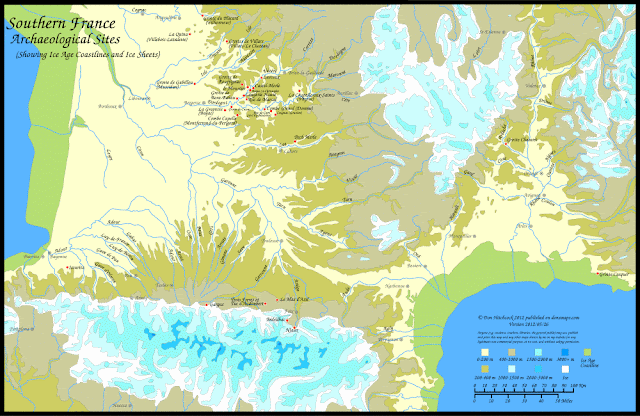
Pg. 106-107: French cave paintings and rock archive - lots of photos.

The map below is in a pdf format here and may be printed.

Cave Painting Locations


Pg 107: The Lena River where Woolly Rhino carcasses were found. No commentary, just beautiful scenery:


Historical references to the Woolly Rhino

Scholarly article with some interesting information on the Woolly Rhino find in Siberia if you'd like to delve into this a bit more.


Pg. 109: The Irish elk - not actually Irish nor elk but a gigantic deer, Megaloceros giganteus. See here and here.

Pg 108 - The Ice Age


Pg 114: Middens - what they are & what they tell us.


Middens provide an insight into earlier occupation of sites. This one, at the NW edge of Traigh na Beirigh, Great Britain, indicates shellfish in the diet.


Pg 116 - Kingsley talks about 'Neanderthal man' in a very derogatary fashion - that he was 'like an ape' & 'would have eaten you if he could.' This article shows how the view of Neanderthal man has changed in recent times.

Over the past several years, the scientific community has witnessed (not always to its liking, I might add) a serious “redefining” of the Neanderthal people. Some anthropologists of the past depicted them as culturally stagnant, if not outright stupid, individuals. In 1996, however, researchers were forced to reevaluate their long-held views on Neanderthals...


I found this video of the Lacaux caves which were discovered in France in 1940, well after Kingsley's time - but it's in French! However, it doesn't look too difficult & I'm going to go through it with Moozle and see how she goes translating it, or the gist of it at least.


Update: Chauvet Cave, France - in English! Thanks to Zoe for the suggestion.


Friday, July 31, 2015

A Peek at a Week - Year 4 Ambleside Online

These are some selections from a week of Ambleside Online Year 4, tweaked & poked to suit an Australian setting. Our remodelled version which we've been using is here and we're in Term 3.

I must admit that when I looked at some of the books on the Year 4 list I doubted that Moozle would understand some of them, let alone enjoy them, but I was willing to try them out and make the decision whether to continue with a couple of the books after that.

...there is no education but self-education, and as soon as a young child begins his education he does so as a student. Our business is to give him mind-stuff, and both quality and quantity are essential. Naturally, each of us possesses this mind-stuff only in limited measure, but we know where to procure it; for the best thought the world possesses is stored in books; we must open books to children, the best books; our own concern is abundant provision and orderly serving.

Philosophy of Education, pg 26 

The two books that I thought would go down like lead balloons were Age of Fable and Rip van Winkle. Before we started Age of Fable, I gave Moozle the D'Aulaire's version of the Greek Myths, which is a lovely book, to read for herself. I thought it might make Age of Fable make more sense but it actually created a problem at first. One book uses the Greek names for the gods and goddesses and the other the Roman names and she'd interrupt me and say things like, "That should be Hera, not Juno!"
Once she got used to who was who, it was fine. The hardest part of Age of Fable is the Preface! It also wasn't included in the online version I was reading so I found it on Librivox and we listened to that together and since then I've been reading the book aloud to her and she is enjoying it. This is a narration she wrote on the last chapter we read:


Now Rip van Winkle, despite my doomsday prophecy, is a book she took to right away. How true of Charlotte Mason's observation,

No one can tell what particular morsel a child will select for his sustenance...

Philosophy of Education, pg 59

 I know that going from Year 3 to Year 4 in the Ambleside Online curriculum is considered quite a jump. Year 4 adds the original Shakespeare plays and Plutarch (some other things as well, but those two seem to be the major hurdles for many people). Moozle has been listening in to Shakespeare & Plutarch for four years along with her older siblings, and understanding quite a bit, so that wasn't a hurdle but some other things were. She's been doing AO all along, and each year after an initial "I don't understand that," with one or two of the scheduled readings, she has grown into the books each time. I just have to remember that's normal.


Hymn Study

We do this together a few times a week and add a new hymn every month or two. Sometimes we stay longer on a hymn we enjoy and sometimes we listen to previous hymns we've learnt.


These are narrations from one of our Australian History books, The History of Australia, which is a well-written and nicely illustrated narrative, first published in 1988. There have been a few editions of this book & the illustrations differ in some. This is the 1995 edition we have:


Our folksong for the month:


We've been listening to the music of Dvorak. We have a set of CD's on various composers I bought a few years ago after listening to one we'd borrowed from the library. We've used the Classical Kids Collection in the past but they don't cover many composers and are more suited to younger children. Introduction to the Classics is suitable for all ages - they are a little old fashioned as they've been around a long time but that doesn't bother us.


Each CD contains a narration of the composer's life interspersed with their music and we've been listening to this as well as focussing on a piece of his music each week. Humoresque is our latest piece. Moozle watches this one below because it features a cello, the instrument she plays, but Benj prefers another version...we usually spend some time comparing different instruments and conductors when we do composer study. It's fascinating to hear the variety of interpretation that a piece of music lends itself to.


Free reading

The Bushboys by James Tierney - a series of books; rereads
Biggles Defies the Swastika by Captain W.E Johns - reread
Pocohontas & Son of Pocohontas by Mari Hanes
Prudence & the Millers by Mildred A. Martin - a reread. Covers health, safety & courtesy from a Biblical perspective.


Linking up with Weekly Wrap-Up


Saturday, July 4, 2015

Madame How & Lady Why: Chapter 5 - The Ice-Plough

I must tell you that there are sometimes—not often, but sometimes—pages in Madam How's book in which one single letter tells you as much as a whole chapter; in which if you find one little fact, and know what it really means, it makes you certain that a thousand other great facts have happened... You feel like Robinson Crusoe when, walking along the shore of his desert island, he saw for the first time the print of a man's foot in the sand. How it could have got there without a miracle he could not dream. But there it was. One footprint was as good as the footprints of a whole army would have been. A man had been there; and more men might come. And in fear of the savages...he went home trembling and loaded his muskets, and barricaded his cave, and passed sleepless nights watching for the savages who might come, and who came after all. 
 
And so there are certain footprints in geology which there is no mistaking; and the prints of the ice-plough are among them. 

Charles Kingsley 


The photo above is of the glaciated Nant Ffrancon valley in North Snowdonia, Wales.
I used some of the resources below just for my own interest & education in this area. The videos would be enjoyed by most children even though they may not understand some of the content. Glaciers, Madame How's ice-ploughs really are a fascinating study.
I've put some other resources on my Ambleside Online Pinterest board.
Also see Ambleside Online's study guide by Katie Barr for this book.

What is a glacier?

A mass of ice which moves down a valley from above the Snowline towards the sea under the force of gravity.


How do glaciers affect land?

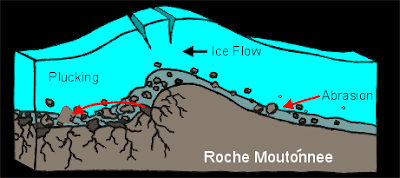
According to my Penguin Dictionary of Geography, more lakes are due to glacial erosion than any other cause. Glaciation is the covering of an area, or the action on an area, by an ice-sheet or glaciers. The video below is a clear and thorough explanation of glacial erosion - 'plucking,' cirques, glacial horns, the formation of roche moutonnées and other landforms - about 7 minutes in length.


Nant Ffrancon is a deeply glaciated and visually dramatic valley in north Snowdonia
- See more at: http://www.visitsnowdonia.info/nant_ffrancon-211.aspx#sthash.9Dd0Nx78.dpuf
Nant Ffrancon is a deeply glaciated and visually dramatic valley in north Snowdonia
- See more at: http://www.visitsnowdonia.info/nant_ffrancon-211.aspx#sthash.9Dd0Nx78.dpuf
Nant Ffrancon is a deeply glaciated and visually dramatic valley in north Snowdonia
- See more at: http://www.visitsnowdonia.info/nant_ffrancon-211.aspx#sthash.9Dd0Nx78.dpuf


Glaciers with chocolate: Did you know that glaciers hold nearly 2% of Earth's water?


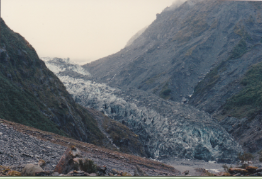
Not the greatest picture - I took this photo of my husband standing in front of the Fox Glacier in the South Island of New Zealand on our honeymoon. It was a very eerie, surreal atmosphere & an awe-inspiring sight.


This one below is the Tasman Glacier at Mount Cook. We took our four eldest children aged 2 to 8 years at the time up the Ball Hut Road when we spent some time living in New Zealand and looked down on this from a different angle. Spectacular, but I was glad to get off the side of Mount Cook. I was waiting for an avalanche to take us all out.


What is an iceberg? 

A mass of land ice which has broken off or "calved" from the end of a glacier or from an ice shelf, and is afloat in the sea.

Pg 88:
Snowdonia - good photos of glacial activity and its effect on the land. Old earth perspective. Some fantastic photos of the area here and here


Pg 89 - the power of ice & snow. Some news photos of effects of a winter storm in New England, January, 2015. 

Pg 91 - Kingsley mentions the Esquimaux (Eskimo) in relation to living in a permanent winter environment. There are many videos related to life in the Arctic but here are two from 1959 and 1950 that I have actually watched & thought were quite good:


What is a Moraine?

Material, mostly rock and soil, left behind by a moving glacier.
Pg 92 & 93

 Mueller Glacier, NZ with moraine in the foreground (Wikiwand)


Pg 94 to 96 - An academic article on glacial geology which I thought tied in well with Kingsley's observations.

'Many of the surficial geologic deposits which are the foundation for the fertile farmland soils and deposits we extract from sand and gravel pits were laid down during glaciation.

Pg 99 - rochers moutonnes: the glacial erosion video above explains these plus other terms very well.


http://www.uoguelph.ca/~sadura/glref/gl42.html


Page 100 - Serpentine rock

Pg 100
Glen Muick

'Spittal' is an old Scots word meaning 'a refuge on a remote hill pass' and is said to come from a time when there were wolves on the hills. Loch Muick lies a short distance away. Lochnagar is on the skyline to the right.

 © Copyright Nigel Corby and licensed for reuse under this Creative Commons Licence

I mentioned this in a previous post on MHLW but it relates to this chapter so here it is again - a PDF for children on glacial erosion and the shaping of the Matterhorn in the Swiss Alps. One mention of millions of years.

Posts for previous chapters of Madame How & Lady Why:

I. The Glen
II. Earthquakes
III. Volcanoes
IV. The Transformations of a Grain of Soil
V. The Ice Plough


Tuesday, June 9, 2015

Australian Natural History - The Emu


On our trip to South Australia a couple of years ago we saw plenty of emus in the open areas of land along the way. These large flightless native birds are second only in size to the world's largest bird, the African ostrich and are also related to the cassowary and the rhea. We've gotten up close to them in captivity and they are ungainly, formidable looking creatures but when you see them in the wild, running through the scrub, they are quite spectacular and beautiful.
This year I read Karrawingi the Emu by Leslie Rees to Moozle. The story follows the life of an emu (Karrawingi is one of the Aboriginal terms for emu) from its birth through to adulthood. It presents a vivid picture of the dangers a young emu encounters, sometimes even before it's hatched out of the egg - wedge-tailed eagles, dingoes, other emus, Aboriginal hunters and farmers are their main enemies.


Karrawingi grows to adulthood, finds a mate and becomes a leader of a great flock. He has numerous children and grandchildren and with the other emus, keeps his distance from man. But hunger and curiosity bring the emus back to the lands where they had roamed previously. They find the land fenced off and farmed and they begin to wreak havoc; breaking fences, devouring the crops and then for a bit of fun, they get in amongst the sheep and their lambs and send them in all directions.
The day comes when Karrawingi is captured and taken to a small town zoo. For ten months he is fed, looked at and laughed over. He becomes used to soft living and at night he dreams confusedly - sweet, yet painful dreams.
One morning Karrawingi awakes to unusual movement. Men come in a van and the gate to the yard opens. His keeper grabs his wings from behind and places him in a box-like van:

What was happening to him now? He was sick with fear of the unknown. So long he had lived at the small town zoo, where the things to do and see hardly varied from month to month, that the sudden change was terror itself, no matter what life was in store for him. He wished he were back in his strong-fenced zoo. There nothing happened, but he was safe.

The van, racing along the gravel road, is far from the nearest town when Karrawingi's eyes fall upon a sight which makes his heart pound - a flock of emus on either side of the road, pacing themselves with the van:

What thoughts the sight sent pounding through his mind! Now he felt himself among the emus, racing with them, now he was a prisoner in the van, his nerves and muscles itching with the desire to get out...
Mile after mile sped by and the emus kept up their gait.
Karrawingi could stand it no longer.

This is an exciting story which conveys in a realistic fashion the nature and habits of the emu. Karrawingi is a very likeable larrikin and while the author isn't overly sentimental, the emu's personality is endearing. I was relieved that the old bird got a chance at freedom again after a great escape, and that the story ended satisfactorily with this realistic comment:

For how long Karrawingi would roam the bush a second time no one could tell. It was enough now that all the wild hot joy of the old days was surfing through his body.

Karrawingi the Emu has been published as a separate book and also as a part of A Treasury of Australian Nature Stories, which contains four other stories by Leslie Rees of various native animals. Both books are out of print but keep your eyes open; it is a real treasure of a story. I think around the age of 9 or 10 years is a good age for Karrawingi. It's certainly not dumbed down and would appeal to anyone interested in the natural world, Australian or otherwise.


Younger children (aged about 4 to 8 years) would enjoy Emu by Claire Saxby. I discovered this at the library and was pleasantly surprised with it. Although not as detailed or literary as Karrawingi, it is well done. It is a good sized picture book - 'a narrative non-fiction.' The left hand-side page contains the story while the right hand page is written in a more factual fashion.


http://www.candlewick.com/bookxtras.asp?isbn=0763674796&id=&browse=Author&view=sprd&sprd=./images/cwp_spreads/648/0763674796.int.2.jpg&bktitle=Emu

There is a PDF document designed for classrooms that has some suggestions for using the book as well as some emu facts. There's a 'look inside' feature on Amazon if you want to have a better idea of what the book contains.

http://www.bookdepository.com/EMU-Claire-Saxby/9780763674793/?a_aid=journey56