Showing posts with label Science. Show all posts

Friday, August 14, 2015

Madame How & Lady Why - Chapter 6: The True Fairy Tale


You like to draw: but why you like it neither you nor any man can tell. It is one of the mysteries of human nature; and that poor savage clothed in skins, dirty it may be, and more ignorant than you (happily) can conceive, when he sat in the cave scratching on ivory the figures of the animals he hunted, was proving thereby that he had the same wonderful and mysterious human nature as you; that he was the kinsman of every painter and sculptor who ever felt it a delight and duty to copy the beautiful works of God.

Madame How & Lady Why


See the Study Guide by Katie Barr at Ambleside Online for helpful commentary on this chapter. Old earth references will be found on some of the sites below.

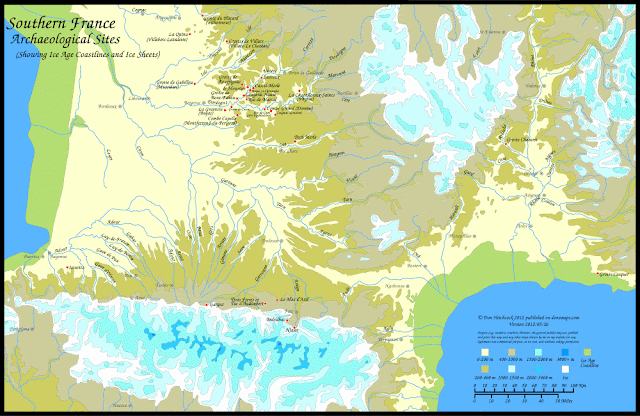
Pg. 106-107: French cave paintings and rock archive - lots of photos.

The map below is in a pdf format here and may be printed.

Cave Painting Locations


Pg 107: The Lena River where Woolly Rhino carcasses were found. No commentary, just beautiful scenery:


Historical references to the Woolly Rhino

Scholarly article with some interesting information on the Woolly Rhino find in Siberia if you'd like to delve into this a bit more.


Pg. 109: The Irish elk - not actually Irish nor elk but a gigantic deer, Megaloceros giganteus. See here and here.

Pg 108 - The Ice Age


Pg 114: Middens - what they are & what they tell us.


Middens provide an insight into earlier occupation of sites. This one, at the NW edge of Traigh na Beirigh, Great Britain, indicates shellfish in the diet.


Pg 116 - Kingsley talks about 'Neanderthal man' in a very derogatary fashion - that he was 'like an ape' & 'would have eaten you if he could.' This article shows how the view of Neanderthal man has changed in recent times.

Over the past several years, the scientific community has witnessed (not always to its liking, I might add) a serious “redefining” of the Neanderthal people. Some anthropologists of the past depicted them as culturally stagnant, if not outright stupid, individuals. In 1996, however, researchers were forced to reevaluate their long-held views on Neanderthals...


I found this video of the Lacaux caves which were discovered in France in 1940, well after Kingsley's time - but it's in French! However, it doesn't look too difficult & I'm going to go through it with Moozle and see how she goes translating it, or the gist of it at least.


Update: Chauvet Cave, France - in English! Thanks to Zoe for the suggestion.


Sunday, July 26, 2015

Living Science Books for the 20th Century: Uncle Tungsten by Oliver Sacks


Uncle Tungsten: Memories of a Chemical Boyhood by Oliver Sacks

Oliver Sacks is a neurologist and an award winning author who has written a number of books based on the case studies of some of his patients. Uncle Tungsten takes a different tack in that it is a memoir of Sacks's boyhood in England: his eccentric, scientific family and Jewish upbringing, experiences of World War II, and his boyhood infatuation with chemistry.

The book is not only a memoir of a life but it interweaves the history of chemistry and pertinent anecdotes in such a seamless narrative that even those with a limited knowledge of chemistry (like me) can follow. Some of the content went above my head in places but I still managed to enjoy and appreciate his writing. In fact about a month ago we had a trip to Questacon, our National Science and Technology Centre in Canberra, and I spent most of the time in the chemistry section. It all had a context for me after reading Uncle Tungsten.


Some of the best features of this book:


* The author filled his story with a boyish enthusiasm. He obviously possessed a mania for chemistry for a period of time when he was younger, but I got the impression it never really left him even though his life took a different direction later on.

*  The number of books the author quoted or mentioned he'd read when he was growing up is fascinating, as is the abundance of footnotes scattered throughout. Literature, science fantasy, biography and history books are referred to. I love it when authors do this. It gives me more of a glimpse into the author's personality and supplies me with ideas for my own reading.
One book he read as a ten year old was Eve Curie's biography of her mother, Madame Curie. I was reading this at the same time as I was reading Uncle Tungsten and thoroughly enjoyed all the connections.

* The historical context. At the outbreak of WWII, when Oliver was six years old, he was evacuated from his home in London to a boarding schooling in the Midlands where he remained for four years. He wrote that it was dehumanising, with beatings, starving and torment and that he was psychologically scarred. He returned to London in 1943 when his parents realised he was 'close to the edge.' How many children during those times suffered in similar ways?

* Uncle Tungsten was the nickname of Sack's Uncle Dave on his mother's side (his factory produced light bulbs using tungsten filament). His whole extended family had scientific inclinations but Uncle Dave was a great encouragement to his nephew in all things regarding metals and provided him with practical opportunities for satisfying his curiosity. My husband had a similar experience with his own uncle who loves gadgets and is always coming up with nifty little inventions. It was his enthusiasm for electronics that inspired my husband to go into electrical engineering.

I'm adding this book to our 20th Century plans for Ambleside Online Year 11. Just so you are a aware, there are a couple of places in the book that contain fairly overt references to adolescent awareness of physical change and maturation (Chapter 22, for instance). Also his family members were interesting and sometimes bordered on the bizarre:

My mother's practice had moved, sometime in the 1930's from general surgery to gynaecology and obstetrics...she would occasionally being back malformed foetuses to the house...
...Some of these had been stillborn, others she and the matron had quietly drowned at birth ("like a kitten," she once said), feeling that if they lived, no conscious or mental life would ever be possible for them. Eager that I should learn about anatomy and medicine, she dissected several of these for me, and then insisted, though I was only eleven, that I dissect them myself. She never perceived, I think, how distressed I became...


Personally, I'd save the book for an older student unless I was reading it aloud. It is a wonderful narrative and fits in well with the time period of AO Year 11 and I'm happy to include it there and discuss these areas as they come up.


Tuesday, July 21, 2015

Living Science Books for the 20th Century: Madame Curie by Eve Curie


This biography of Marie Curie (1867-1934) published in 1937, was written by her daughter, Eve.
I started reading it about two years ago and found it a little slow going at first, but about a third of the way through the book, Marie (Manya) Sklodovski met Pierre Curie, her future husband, and I really began to enjoy it.


In 1867, Manya Sklodovski was born into a Polish family, in what was then Russian Poland. The Polish people had rebelled against their oppressors in the past and had been severely punished. Now the battleground had changed and it was the intellectuals, the artists and the teachers who carried on the resistance.
Manya spent her early school years in clandestine Polish history lessons, interrupted at times by the despised Russian school inspectors. She was to retain her nationalist fervour all her life.
By the time Manya was 10 years of age, she had lost a sister to typhus and her mother, a devout Catholic, to tuberculosis. Although Manya had been a Christian by upbringing, her mother's death had shaken her faith, and by the time she was seventeen years old it had evaporated completely.

From the devoutness of her childhood there remained only vague aspirations, the unconscious wish to adore something very high and great.

Marie's dream was to study science at the Sorbonne in France but she had to spend six years as a governess before she was financially able to achieve her dream in 1891.

The part of the book I enjoyed most was the account of the dedication shown by the Curies in their search to discover Radium. Throughout years of hardship, four of them spent working in a dilapidated shed, they continued to be fascinated by a material which resisted their efforts to divulge its secrets, until finally they were able to announce the existence of Radium.

What does it matter to Science if her passionate servants are rich or poor, happy or unhappy, healthy or ill? She knows that they have been created to seek and to discover, and that they will seek and find until their strength dries up at its source.

Fame came upon the couple and they were awarded the Nobel Prize for Physics along with Henri Becquerel, but the attention they received after this 'dispossessed them of the only treasures they wished to preserve: meditation and silence.'
Fame leaps upon the great, hangs its full weight upon them, attempts to arrest their development.


Pierre Curie was killed in a tragic accident in 1906 leaving his devastated wife to continue alone. By this stage they had two young daughters, Irene (later a famous scientist herself) and Eve, the writer of this biography.
In 1911 Marie was awarded her second Nobel Prize, this time in Chemistry (she was the first woman to receive the Nobel Prize and the only person to receive it twice). Around this time she was involved in a personal scandal which the French press capitalised on, calling her "the foreign woman."
In her book, Marie Curie and the Science of Radioactivity, Naomi Pasachoff writes that Marie received a letter from a committee member of the Academy of Sciences advising her to:

...decline the prize until it had been proven that the accusations...were false. In a dignified response she indicated why she would not accept his advice: it was for her science, not her personal conduct, that had been deemed worthy of honor. The value of her discovery should in no way be diminished by rumours about her private life. Therefore she would accept the prize.


In 1914, at the outbreak of WWI, Marie used her scientific knowledge to put the first 'radiological car,' into action. These mobile X-ray stations were later nicknamed 'little Curies.'
As well as the twenty cars she equipped for this purpose, she also installed two hundred radiological rooms which were said to have treated over a million wounded men!

Some thoughts:

* The book was originally written in French and translated into English by Vincent Sheean. In some places it seems to have suffered a little in the translation but otherwise it is beautifully written.

* Eve Curie wrote a very loving and moving account of her mother's life but it did tend to depict her as almost saint-like. She had witnessed the vilification of her mother by French journalists and her rejection by the scientific authorities on the basis of race and gender, and I think it understandable that Eve Curie had no desire to revisit those times.
She summed up her view in these words:

Great men have always been subjected to the attacks of those who long to discover imperfect human creatures beneath the armour of genius. Without the terrible magnet of renown which had drawn sympathies and hatred upon her, Marie Curie would never have been criticised or calumniated. She now had another reason for hating fame.

* The Curies refused to patent their discoveries, which would have benefitted them financially and made their work much easier. They wanted others to be free to use the knowledge they had obtained.

* Both scientists were indifferent to the dangers of radioactivity. Pierre once exposed his arm to the effects of radium in order to describe and report on its actions. Marie died of aplastic anaemia when she was sixty-seven years old.

... the radiation of radium was "contagious" - contagious like a persistent scent or a disease.

This contagion, which interfered with the results of precise experiments, was a daily enemy to Pierre and Marie Curie.


A hundred years later, the Curie's notebooks are still radioactive.

 ...the radio elements formed strange and cruel families in which each member was created by the spontaneous transformation of the mother substance: radium was a "descendant" of uranium, polonium a descendant of radium.

I'll be including this book in our Year 11 Ambleside Online plans but it would be suitable for younger students, around 14 years of age and up (but read Annie Kate's comment below).
(Caveat: Chapter XVII mentions a period when the Curies took a 'strange path' and explored 'this dangerous region.' This referred to their involvement in spiritism which Marie abandoned after a few years but it doesn't go into much detail)
The book has been reprinted but is also available free online.

For younger readers:

The Story of Madame Curie by Alice Thorne is a Signature Biography which has made use of some of the dialogue from Eve Curie's book. It would fit well chronologically in Term 3 of Ambleside Online Year 5.


Wednesday, July 15, 2015

Science & Natural History with a 15 Year old Boy

In my last post I shared some thoughts on coming to Ambleside Online late, and the adjustments I made with my older children. This post follows on from some of what I wrote there as it concerns Benj who started AO when he was 12 years of age.

He is nearing the end of AO Year 8 and as many of you would know, this particular year has been updated recently to add in living books for science. Apart from Phineas Gage, one of the new additions which he'd already read a couple of years ago, we've just continued with the book selections before the new plans were added. I added in books to bring him more into line with his actual grade level of Year 10.


What he's done this year:

Natural History - we continue to use Insect Life in Australasia by William Gillies for our special studies. There's a good article here which explains how to implement these studies. We've been doing this once a week as well as continuing with nature walks. In the past two weeks we had a day at the beach and an afternoon/early evening walk at the riverside.

Understanding Physics by Isaac Asimov - he's enjoying this book and earlier in the year used Apologia Physical Science for experiment ideas which worked quite well. I found some interesting  videos recently I knew would appeal to him - posted here - and the notebook page above was based on one of them.

Apologia Biology - I picked out a few modules for him to work through; mostly the sections on the cell & DNA. It's a fairly dense book and he's more interested in other areas of science but I'd like him to do some biology and will probably include a biography or other narrative science book on this subject when I find one I like.

From the Year 8 selections:

The Microbe Hunters
William Harvey and the Discovery of the Circulation of the Blood 
Johann Kepler bio


Pelicans checking out the local fisherman


Special Study - Insects


From Benj's Biology readings:


The sun descending in the west,   
  The evening star does shine;   
The birds are silent in their nest.   
  And I must seek for mine.

William Blake


Saturday, July 4, 2015

Madame How & Lady Why: Chapter 5 - The Ice-Plough

I must tell you that there are sometimes—not often, but sometimes—pages in Madam How's book in which one single letter tells you as much as a whole chapter; in which if you find one little fact, and know what it really means, it makes you certain that a thousand other great facts have happened... You feel like Robinson Crusoe when, walking along the shore of his desert island, he saw for the first time the print of a man's foot in the sand. How it could have got there without a miracle he could not dream. But there it was. One footprint was as good as the footprints of a whole army would have been. A man had been there; and more men might come. And in fear of the savages...he went home trembling and loaded his muskets, and barricaded his cave, and passed sleepless nights watching for the savages who might come, and who came after all. 
 
And so there are certain footprints in geology which there is no mistaking; and the prints of the ice-plough are among them. 

Charles Kingsley 


The photo above is of the glaciated Nant Ffrancon valley in North Snowdonia, Wales.
I used some of the resources below just for my own interest & education in this area. The videos would be enjoyed by most children even though they may not understand some of the content. Glaciers, Madame How's ice-ploughs really are a fascinating study.
I've put some other resources on my Ambleside Online Pinterest board.
Also see Ambleside Online's study guide by Katie Barr for this book.

What is a glacier?

A mass of ice which moves down a valley from above the Snowline towards the sea under the force of gravity.


How do glaciers affect land?

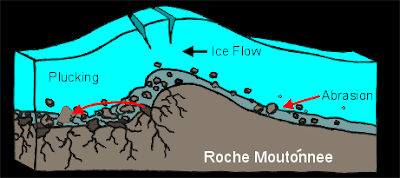
According to my Penguin Dictionary of Geography, more lakes are due to glacial erosion than any other cause. Glaciation is the covering of an area, or the action on an area, by an ice-sheet or glaciers. The video below is a clear and thorough explanation of glacial erosion - 'plucking,' cirques, glacial horns, the formation of roche moutonnées and other landforms - about 7 minutes in length.


Nant Ffrancon is a deeply glaciated and visually dramatic valley in north Snowdonia
- See more at: http://www.visitsnowdonia.info/nant_ffrancon-211.aspx#sthash.9Dd0Nx78.dpuf
Nant Ffrancon is a deeply glaciated and visually dramatic valley in north Snowdonia
- See more at: http://www.visitsnowdonia.info/nant_ffrancon-211.aspx#sthash.9Dd0Nx78.dpuf
Nant Ffrancon is a deeply glaciated and visually dramatic valley in north Snowdonia
- See more at: http://www.visitsnowdonia.info/nant_ffrancon-211.aspx#sthash.9Dd0Nx78.dpuf


Glaciers with chocolate: Did you know that glaciers hold nearly 2% of Earth's water?


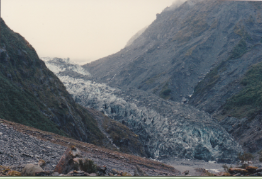
Not the greatest picture - I took this photo of my husband standing in front of the Fox Glacier in the South Island of New Zealand on our honeymoon. It was a very eerie, surreal atmosphere & an awe-inspiring sight.


This one below is the Tasman Glacier at Mount Cook. We took our four eldest children aged 2 to 8 years at the time up the Ball Hut Road when we spent some time living in New Zealand and looked down on this from a different angle. Spectacular, but I was glad to get off the side of Mount Cook. I was waiting for an avalanche to take us all out.


What is an iceberg? 

A mass of land ice which has broken off or "calved" from the end of a glacier or from an ice shelf, and is afloat in the sea.

Pg 88:
Snowdonia - good photos of glacial activity and its effect on the land. Old earth perspective. Some fantastic photos of the area here and here


Pg 89 - the power of ice & snow. Some news photos of effects of a winter storm in New England, January, 2015. 

Pg 91 - Kingsley mentions the Esquimaux (Eskimo) in relation to living in a permanent winter environment. There are many videos related to life in the Arctic but here are two from 1959 and 1950 that I have actually watched & thought were quite good:


What is a Moraine?

Material, mostly rock and soil, left behind by a moving glacier.
Pg 92 & 93

 Mueller Glacier, NZ with moraine in the foreground (Wikiwand)


Pg 94 to 96 - An academic article on glacial geology which I thought tied in well with Kingsley's observations.

'Many of the surficial geologic deposits which are the foundation for the fertile farmland soils and deposits we extract from sand and gravel pits were laid down during glaciation.

Pg 99 - rochers moutonnes: the glacial erosion video above explains these plus other terms very well.


http://www.uoguelph.ca/~sadura/glref/gl42.html


Page 100 - Serpentine rock

Pg 100
Glen Muick

'Spittal' is an old Scots word meaning 'a refuge on a remote hill pass' and is said to come from a time when there were wolves on the hills. Loch Muick lies a short distance away. Lochnagar is on the skyline to the right.

 © Copyright Nigel Corby and licensed for reuse under this Creative Commons Licence

I mentioned this in a previous post on MHLW but it relates to this chapter so here it is again - a PDF for children on glacial erosion and the shaping of the Matterhorn in the Swiss Alps. One mention of millions of years.

Posts for previous chapters of Madame How & Lady Why:

I. The Glen
II. Earthquakes
III. Volcanoes
IV. The Transformations of a Grain of Soil
V. The Ice Plough


Thursday, June 18, 2015

Snippets of a Week Of Ambleside Online Year 8 with a 15 Year old

*  History readings as per Ambleside Online schedule. Benj plans his own readings from the weekly list. With Churchill's books, he has always preferred to read a whole chapter per week rather than how it is scheduled (the chapters are divided as they are fairly long) so he has just finished the book this week.

*  Shakespeare's Macbeth - we've just started this play using the Arkangel BBC recording.

http://www.bookdepository.com/Macbeth-William-Shakespeare/9781932219203/?a_aid=journey56


*  We're not doing a Plutarch Life this term as our days are full enough at present. I'm happy if we do at least two Shakespeare and two lives per year but sometimes we do more.

*  The Holy War by John Bunyan - each week Benj adds to his poetic saga narration.

*  Francis Bacon Essays - a re-writing of the essay Of Studies.
There were a few Latin phrases such as, Abeunt studia in mores and cymini sectores, which we were unsure of until we found this site which helps explain them.


Maths - continues with Saxon Algebra II which he's almost finished. We were talking this week about what he'd like to study at University so we can plan towards that. We've used the SAT and units from Open University as a means of providing 'formal' documentation for university entry and as he has a mathematical bent, we'll probably get him to do some subjects related to that starting either this year or the beginning of next.

He watched this video this week:


Science

Understanding Physics by Isaac Asimov - Volume 1: Motion, Sound & Heat.
Science Notebook & experiments
Apologia Exploring Creation With Biology - selected modules only

Combining two loves, mathematics & soccer:


Art & Poetry


 La Belle Dame Sans Merci by John William Waterhouse (1893)

 The painting above is based on John Keats' 1819 poem of the same name.

I really liked the sound of this book when I saw it on Janice Campbells's Excellence in Literature site and thought it would be good for me to work through myself as a devotional. So I am, but Benj is also now using it to read through the poems of George Herbert, which are unique & beautiful. Working it Out: Growing Spiritually with the Poetry of George Herbert by Joseph L. Womack.

http://www.bookdepository.com/Working-It-Out-Joseph-Womack/9781613220344/?a_aid=journey56

There is a sample of the book here.
At the beginning of the book is a short section in which Janice Campbell gives suggestions on using the book in the writing process.


Linking to Weekly Wrap-up

Books for Beginning Readers: Nature & Science

Finding an interesting selection of books to bridge the gap from when a child first begins to read until they are able to read with sufficient fluency can be difficult, especially if that time period is prolonged. I'll be posting books that worked well for us at this stage, dividing them into different categories.  Most of them work well for around the ages of 4 to 8 years. I read these aloud (many times over) to my non-readers but my children loved to read them on their own when they first started reading for themselves. The 'Science I CAN READ' books are well-illustrated and interesting, narrative non-fiction and there is a wide range available secondhand. These are some we used & liked:

Elephant Seal Island by Evelyn Shaw


A Nest of Wood Ducks by Evelyn Shaw


Red Tag Comes Back by Fred Phleger


Ants Are Fun by Mildred Myrick


Caterpillar Green by Marla Martin

This book is published by Rod & Staff Publishers and is unusual in that it is a chapter book of 139 pages of good sized print with words broken down into syllables. The story is about a classroom of children who follow the journey of a green caterpillar as it becomes a beautiful butterfly. The story is told in both prose and poetry and is helpful in developing reading fluency with words of multiple syllables in the context of an interesting aspect of the natural world.


The Microscope by Maxine Kumin 

An illustrated poem about the Dutch scientist, Anton van Leeuwenhoek, who was more interested in looking through his handmade microscopes than in keeping his shop. He saw things with the microscope that no one had ever seen before.


Germs Make Me Sick by Melvin Berger

'Germs all all around you, but they are too small for you to see. Many germs are harmless, but two kinds, viruses and bacteria, can make you sick. Read and find out about germs, how they make you sick, and how your body works to fight them off and keep you healthy.''


Monday, May 25, 2015

Madame How & Lady Why: Chapter 4 - The Transformation of a Grain of Soil

'Why, you ask, are there such terrible things as volcanos? Of what use can they be?'


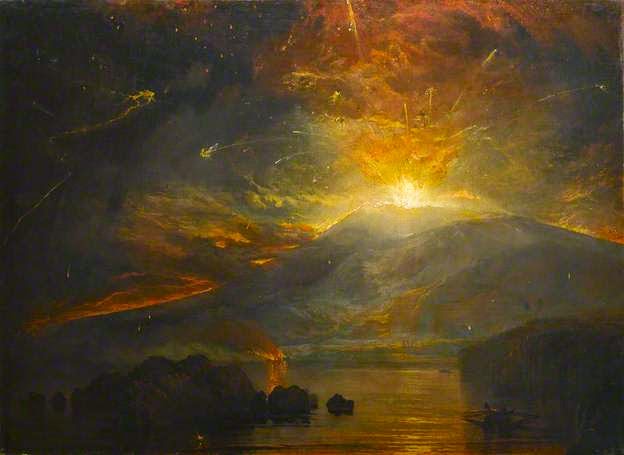
The Eruption of the Souffrier Mountains, in the Island of St Vincent, at Midnight, on the 30th of April, 1812, from a Sketch Taken at the Time by Hugh P. Keane, Esqre by Joseph Mallord William Turner

the-eruption-of-the-soufriere-mountains-in-the-island-of-s67007


Pg 71 - The flow of a lava stream. This BBC site has some spectacular photos of lava flows.

Pg 72-73 - Trees ( I've put some pictures of these plus additional pictures & videos of other subjects on my Ambleside Online board at Pinterest).

Pg 73-74 - Kingsley tells about the threat by the eruption of Mt Etna on the town of Catania in Sicily. The story of Catania is also told by Fabre in The Story Book of Science. Fabre has a kinder attitude to the inhabitants of the town in his rendering of the story.

 Pg 74 - Lava entering the sea Hawaii (or Sandwich Islands as they used to be known).


I posted a video on the Mt St Helen's eruption which showed the damage done by the volcano to the fish population in Spirit Lake: MHLW: Part 3 - Volcanoes.
There are some spectacular photos of lava from a vent in Hawaii's Kilauea volcano as it reaches the sea on this National Geographic website. 


And now you will ask me, with more astonishment than ever, what possible use can there be in these destroying streams of fire? And certainly, if you had ever seen a lava stream even when cool, and looked down, as I have done, at the great river of rough black blocks streaming away far and wide over the land, you would think it the most hideous and the most useless thing you ever saw. And yet, my dear child, there is One who told men to judge not according to the appearance, but to judge righteous judgment. He said that about matters spiritual and human: but it is quite as true about matters natural, which also are His work, and all obey His will.


Pg 75 - The richness of volcanic soils. This short article answers the question of 'Why do people live on volcanoes?' 'Volcanic ash can be considered as a time-release capsule, rich in nutrients.'

Of course, when the lava first cools on the surface of the ground it is hard enough, and therefore barren enough. But Madam How sets to work upon it at once, with that delicate little water-spade of hers, which we call rain, and with that alone, century after century, and age after age, she digs the lava stream down, atom by atom, and silts it over the country round in rich manure. So that if Madam How has been a rough and hasty workwoman in pumping her treasures up out of her mine with her great steam-pumps, she shows herself delicate and tender and kindly enough in giving them away afterwards. 


Pg 78 - The 1812 eruption of St Vincent in the West Indies was witnessed by plantation owner and barrister, Hugh Perry Keane. He recorded his observations in a diary and also made a sketch which was what Turner based his painting above upon.

The Commonwealth


Pg 80 - Madame How's remaking of the land. The book below would be interesting for a child who's not an independent reader. It's recommended for Grades 2 to 4 and is based on the eruption of the Paricutin volcano (the volcano in a cornfield) in Mexico in 1943. I borrowed this book from the library years ago and it was a hit with the boys.


 Pg 77 - Kingsley mentions atoms in a few places and I found this video which gives a simple and clear explanation on atoms, molecules and bonding.


What's all the matter? Atoms and Molecules: Atoms, elements and molecules. Understanding the building blocks of matter.


 Pg 84  - there's a brief mention of millions of years

The Gallery of Natural Phenomena has some topics of general interest relating to what is covered in MHLW.

Paricutin

I forgot to add this video on the rock cycle:


For Resources for Chapter 5 of MHLW, The Ice-Plough see here.