Showing posts with label Science Videos. Show all posts

Monday, May 25, 2015

Madame How & Lady Why: Chapter 4 - The Transformation of a Grain of Soil

'Why, you ask, are there such terrible things as volcanos? Of what use can they be?'


The Eruption of the Souffrier Mountains, in the Island of St Vincent, at Midnight, on the 30th of April, 1812, from a Sketch Taken at the Time by Hugh P. Keane, Esqre by Joseph Mallord William Turner
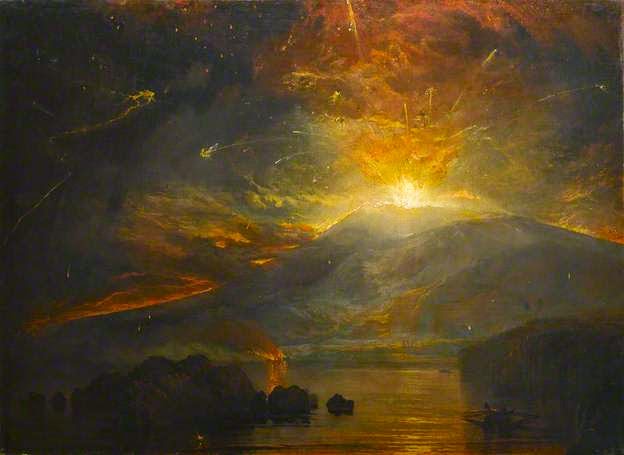
the-eruption-of-the-soufriere-mountains-in-the-island-of-s67007


Pg 71 - The flow of a lava stream. This BBC site has some spectacular photos of lava flows.

Pg 72-73 - Trees ( I've put some pictures of these plus additional pictures & videos of other subjects on my Ambleside Online board at Pinterest).

Pg 73-74 - Kingsley tells about the threat by the eruption of Mt Etna on the town of Catania in Sicily. The story of Catania is also told by Fabre in The Story Book of Science. Fabre has a kinder attitude to the inhabitants of the town in his rendering of the story.

 Pg 74 - Lava entering the sea Hawaii (or Sandwich Islands as they used to be known).


I posted a video on the Mt St Helen's eruption which showed the damage done by the volcano to the fish population in Spirit Lake: MHLW: Part 3 - Volcanoes.
There are some spectacular photos of lava from a vent in Hawaii's Kilauea volcano as it reaches the sea on this National Geographic website. 


And now you will ask me, with more astonishment than ever, what possible use can there be in these destroying streams of fire? And certainly, if you had ever seen a lava stream even when cool, and looked down, as I have done, at the great river of rough black blocks streaming away far and wide over the land, you would think it the most hideous and the most useless thing you ever saw. And yet, my dear child, there is One who told men to judge not according to the appearance, but to judge righteous judgment. He said that about matters spiritual and human: but it is quite as true about matters natural, which also are His work, and all obey His will.


Pg 75 - The richness of volcanic soils. This short article answers the question of 'Why do people live on volcanoes?' 'Volcanic ash can be considered as a time-release capsule, rich in nutrients.'

Of course, when the lava first cools on the surface of the ground it is hard enough, and therefore barren enough. But Madam How sets to work upon it at once, with that delicate little water-spade of hers, which we call rain, and with that alone, century after century, and age after age, she digs the lava stream down, atom by atom, and silts it over the country round in rich manure. So that if Madam How has been a rough and hasty workwoman in pumping her treasures up out of her mine with her great steam-pumps, she shows herself delicate and tender and kindly enough in giving them away afterwards. 


Pg 78 - The 1812 eruption of St Vincent in the West Indies was witnessed by plantation owner and barrister, Hugh Perry Keane. He recorded his observations in a diary and also made a sketch which was what Turner based his painting above upon.

The Commonwealth


Pg 80 - Madame How's remaking of the land. The book below would be interesting for a child who's not an independent reader. It's recommended for Grades 2 to 4 and is based on the eruption of the Paricutin volcano (the volcano in a cornfield) in Mexico in 1943. I borrowed this book from the library years ago and it was a hit with the boys.


 Pg 77 - Kingsley mentions atoms in a few places and I found this video which gives a simple and clear explanation on atoms, molecules and bonding.


What's all the matter? Atoms and Molecules: Atoms, elements and molecules. Understanding the building blocks of matter.


 Pg 84  - there's a brief mention of millions of years

The Gallery of Natural Phenomena has some topics of general interest relating to what is covered in MHLW.

Paricutin

I forgot to add this video on the rock cycle:


For Resources for Chapter 5 of MHLW, The Ice-Plough see here.

Tuesday, April 14, 2015

Madame How & Lady Why - Part 3: Volcanoes

'And wherever there are volcanos there will be earthquakes. You may have earthquakes without volcanos, now and then; but volcanos without earthquakes, seldom or never.
How does that come to pass? Does a volcano make earthquakes? No; we may rather say that earthquakes are trying to make volcanos. For volcanos are the holes which the steam underground has burst open that it may escape into the air above. They are the chimneys of the great blast-furnaces underground, in which Madam How pounds and melts up the old rocks, to make them into new ones, and spread them out over the land above.'

Madame How & Lady Why by Charles Kingsley


An 1888 Lithograph of the 1883 Eruption of Krakatoa.
Lithograph of 1883 Krakatoa Eruption


'Cone, crater, lava: those words make up the alphabet of volcano learning. The cone is the outside of a huge chimney; the crater is the mouth of it. The lava is the ore which is being melted in the furnace below, that it may flow out over the surface of the old land, and make new land instead.'


Ambleside Online has a guide by Katie Barr which provides background information on the book and the following are some of the rabbit trails we pursued as we went through Chapter 3 of MHLW which was all about volcanoes. You'll find some information repeated in the different videos and websites but it's a fascinating subject and we thought they were all helpful.

Pg. 49 - Kilauea Volcano in Hawaii (Kingsley refers to Hawaii as the Sandwich Islands, the name given to them by Captain James Cook in 1778).


Volcano 101 - very good; explains the different types of volcanoes; one view of a 'mummy' from the ruins of Pompeii:


What is the common link between earthquakes, volcanoes, and tidal waves? An ABC Splash video with transcript.


Below - good, simple video on how volcanoes are formed and continental drift. One mention of millions of years towards the end.


Geography - Seterra, a free programme that can be used online or downloaded (which is how we use it) has a world mountains and volcanoes map game.

Pg 54 - Mt. Vesuvius

Pliny the Younger, witness to a catastrophe. Great site with two videos of Pliny's observations of the Vesuvius eruption in 79AD.

The destruction of Pompeii - some information at 'Eyewitness to History.'


Short video on Mt Vesuvius facts and narration of Pliny the Younger:


Mt Vesuvius erupts near Naples, Italy in 1944:


Excellent website on the Mt Vesuvius eruption during World War II. Probably of more interest to an older child but I think most boys would love it.

A 2009 aerial view of a very different Mt Vesuvius:


The active volcano island of Krakatoa lies between the islands of Java and Sumatra in the Sundra Strait, and is one of the most dangerous volcanoes in the world.


New Zealand Volcanoes

We were living in New Zealand between the 1995 and 1997 eruptions of Mt Ruapehu. I thought it was bizarre to be playing in the snow on a mountain which had erupted in recent times but my husband, being a New Zealander, took it in his stride. He thinks Aussies are crazy to ski on snow fields that have trees sticking up out of them.
One of his cousins is a volcanologist and it made me feel slightly better that he thought the mountain was safe enough the day we went up. Only slightly. I was making escape plans in my head all the time I was up there.
An article from The Earthquake Commision - Remembering the 1995 Mt Ruapehu Eruption.

The Institute of Geological and Nuclear Science (GNS) has lesson plans and information on the volcanoes of New Zealand and a fact sheet on Ruapehu which is the largest active volcano in NZ.

The Waimangu Volcanic Valley is a geothermal system at Rotorua in the North Island of New Zealand which we visited on our honeymoon. An eerie and beautiful place.

Crater Lakes, Pg 63

 Inferno Crater Lake, New Zealand
Inferno Crater Lake, New Zealand


Mt. St. Helen's Eruption May 18, 1980


A sweep of Cotopaxi (see Pg 60 of MHLW) at 5897 meters. Located in Equador in South America


New island formed by volcanic eruption, Japan 2013:


Monday, October 6, 2014

Free Science Resources

We've used the videos below alongside Apologia Science, Secrets of the Universe (Ambleside Online Year 7), The Mystery of the Periodic Table, by Benjamin Wiker and Archimedes and the Door of Science by Jeanne Bendick (AO Year 6).


The Periodic Table

We've been using the University of Nottingham videos to go through the periodic table. Each element is explained and some experiments are shown with a good dash of humour thrown in.


http://www.bookdepository.com/Mystery-Periodic-Table-Ben-Wiker/9781883937713/?a_aid=journey56


A photographic table showing the elements. Click on the element to see a photo and description. For example this page on Titanium, something we were talking about after the dentist explained how it came to be used in humans for implants.

The Periodic Table in song in the order of the elements:


Physics

Professor Julius Sumner Miller’s TV Show “Why Is It So?” was broadcast in Australia on the ABC from 1963 to 1986. We've used a number of his videos to supplement our science studies. I've put some of those below and this website has a list of others we've also used.
The following videos fit with this book:


Liquids & Gases

 Pascal's Law - Part 1


Pascal's Law - Part 2


http://www.bookdepository.com/Archimedes-Door-Science-Jeanne-Bendick/9781883937126/?a_aid=journey56


Archimedes - Part 1


Archimedes - Part 2 (just don't go putting your fingers in the mercury)


'Why doesn't the temperature rise as we get higher?' This question came up recently and as my boys really enjoy Top Gear this video was helpful.


And then we added this one, Where Does the Atmosphere End?


Friday, June 13, 2014

Science Videos & Schedule for A Child's Geography: Explore His Earth by Ann Voscamp

I've just finished reading this book to my 9 year old. The book is pitched to the younger child in the way the author writes (Ambleside Online has it listed as a Geography option for Year 3) but my son read it when he was about 11 years old and enjoyed it and I learnt quite a bit myself when I read it to Moozle as it goes into quite some depth in places. See here for an excerpt.


There are 11 chapters and I spaced each chapter over two weeks, occasionally three (chapters 8-10 were quite detailed), reading a few sections per week and she narrated after each section.
We skipped the writing suggestions (Postcards Home) and most of the activities except for those Moozle decided were interesting enough to warrant an effort and I added in some videos.
This is an outline of what we did.

Chapter 1

Short & easily done in a week.
Pg 9-11; 12-13
Countries & coastlines (but sadly no Australia!) 


Earth from space:


Chapter 2

Pg.19-20; 21-22; 23-25

Meteors & shooting stars at the Science Channel - quite a good video but there are links to other videos & an ad beforehand as well so preview first.

Atmosphere song:


Chapter 3

Pg. 31-33; 33-35; 35-37

Auroras seen from the north of Scotland. This is spectacular:


A very good explanation of what causes the above, especially for an older child:


Chapter 4

Pg.43-45; 45-46; 47- 49; 49-50; 51-52

Sheppard Software have some free online map activities which are great for all ages. Some of them are quite difficult but with a bit of practice you'll know all the Chinese provinces and other random information that might just be useful one day...

Chapter 5

Pg.57-59; 60-62; 63-64; 65-66
Activity pg. 71-72


Learn about rip currents, how to identify them, avoid them or how to escape if caught in one. We had a holiday last year and swam at an isolated beach which had some strong rips and we spent some time looking for the safest places to swim. I never knew how to identify rips and I was caught in one when I was in my teens - very frightening, not to mention highly dangerous. If I'd had this information at the time I would have known what to do.

The moon & tides:


The Gulf Stream - a bit of history here. Benjamin Franklin was the first person to map the Gulf Stream:


Ocean currents & Salinity - simple visual explanation:


Chapter 6

Pg.73-76; 77-78; 79-80; 80-81

An explanation of the seasons:


Chapter 7

Pg. 91-93; 94-96; 97-99; 100-101

This video on earthquakes is very good but I only let my daughter watch it up until 2:10 as it has footage of a little girl crying as an earthquake occurs and people being swept away by tsunamis later on. It has a great view of the San Andreas fault line and it would probably be fine for an older student but preview first.


Chapter 8

105-107; 108-109; 109-110; 111-113
Activity pg 116-117 & 118

Good explanation of plate tectonics for children:


Chapter 9

Pg.119-122; 123-125; 126-128; 128-129

Volcano Adventure is a great book I'd recommend while we're on the topic of volcanoes.
Activity pg 133-134 - the results weren't spectacular. Last time one of the boys made a volcano in the sandpit and it was impressive.


Cinder, composite and shield volcanoes & how they are formed:


Geysers - what they are and how they erupt:


Rotorua Geysers, New Zealand. Rotorua has been called The Sulphur City and the geothermal activity permeates the area with a distinctive odour. The colours of the rocks, terraces and water (a beautiful intense aqua in places), around the area are stunning.


Chapter 10

Pg.135-137; 138-140; 140-141; 142-144

Globe Unwrapped shows how a globe becomes a map (the website is slow to load).

Chapter 11

Pg.149-151; 152-153; 153-155; 156-159

Concise & clear explanation of the Prime Meridian:


We were trying to work out time differences when my husband was overseas for work.
How come where Dad is it's Wednesday and he's just about to go to bed and it's Thursday lunchtime here??
These videos were helpful:


The concept of different times in different places takes some mind bending so this video might go over the heads of younger children and would be better for an older student: